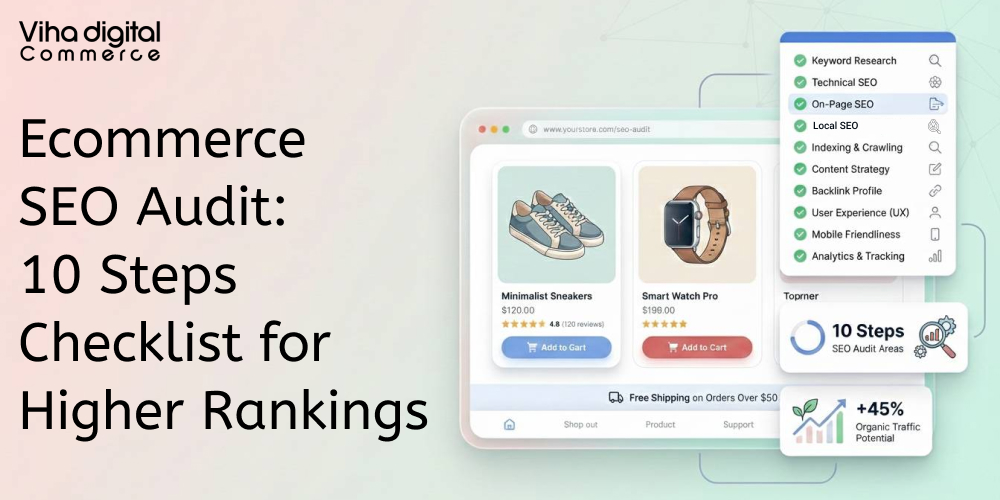
Ecommerce SEO Audit: 10 Steps Checklist for Higher Rankings
If you run an online store, your success depends on one simple truth: people must be able to find your products before they can buy them. That’s exactly why every growing ecommerce brand needs a structured, data-driven Ecommerce SEO Audit. Without it, even the most beautifully designed store will lose visibility, traffic, and sales.
An SEO audit acts as a health check for your ecommerce website. It uncovers hidden issues, ranking blockers, missed optimization opportunities, and technical gaps that prevent Google from understanding or ranking your website. In this guide, we break down a 10-step Ecommerce SEO Audit checklist designed specifically to help stores dominate search results in 2026 and beyond.
Let’s dive into what an ecommerce SEO audit is, why it matters, and how you can execute each step effectively.
What Is an Ecommerce SEO Audit?
An Ecommerce SEO Audit is a complete evaluation of how well your online store follows SEO best practices. It analyzes factors like crawlability, site speed, product page quality, structured data, keyword targeting, indexing, content gaps, and on-page optimization.
Unlike basic SEO audits, an ecommerce-focused audit digs deeper into product structure, category navigation, duplicate content, faceted URLs, mobile UX, schema markup, and conversion impacts.
In simple terms, it answers one question:
Is your ecommerce website fully optimized to rank and convert?
Why Does Ecommerce Need SEO Audit?
Because ecommerce sites naturally deal with:
- Thousands of product pages
- Constantly changing inventory
- Duplicate content risks
- URL parameter issues
- Heavy scripts and media slowing the site
- Complex category hierarchies
- Bigger indexing challenges
Without regular ecommerce SEO audit services, your rankings will slowly decline — even if your website looks fine.
A proper audit leads to:
- Higher visibility
- Better product page rankings
- Faster performance
- Clearer site structure
- Increased organic sales
In short, an ecommerce SEO audit isn’t optional—it’s the foundation of sustainable growth.
Now, let’s dive into the heart of this guide: your complete 10-step Ecommerce SEO checklist.
10-Step Ecommerce SEO Audit Checklist for Higher Rankings
Below is the most detailed, beginner-friendly yet highly advanced eCommerce website audit checklist.
Follow each step carefully and your rankings will improve dramatically.
Step 1. Crawl Your Website and Fix Indexing Issues
Start by crawling your entire website using any of the best ecommerce SEO tools 2026 (like Screaming Frog, Sitebulb, or Ahrefs).
Identify:
- Broken links
- Redirect loops
- Orphan pages
- Duplicate pages
- Non-canonical URLs
- Thin content pages
- Non-indexable product pages
Goal: Ensure Google can crawl and index the correct URLs.
This step is the foundation of Ecommerce technical SEO.
Step 2. Analyze Site Speed and Core Web Vitals
Speed matters more for ecommerce than any other sector.
During your eCommerce website audit, evaluate:
- LCP (Largest Contentful Paint)
- CLS (Cumulative Layout Shift)
- FID/INP (Interaction to Next Paint)
Slow product pages kill conversions and rankings.
To improve:
- Compress images
- Remove unused JS/CSS
- Enable lazy loading
- Use a CDN
- Upgrade hosting
Technical SEO for ecommerce must prioritize speed because slow-loading product pages drastically reduce revenue.
Step 3. Check Mobile Usability
More than 70% of ecommerce traffic comes from mobile.
Your Ecommerce website SEO must include:
- Responsive layouts
- Mobile-friendly product pages
- Easy tap targets
- Sticky add-to-cart
- Fast mobile loading time
If your mobile UX is broken, your rankings drop — instantly.
Step 4. Fix Duplicate Content and Canonical Issues
The biggest ecommerce SEO mistake to avoid:
duplicate content across product variations and categories.
Audit:
- Product variants (size/color)
- Category and subcategory pages
- Filtered URLs
- Pagination
Use canonical tags correctly to make sure the main version of the page ranks.
Step 5. Optimize Category Pages for Better Rankings
Category pages often carry the highest revenue potential.
Your Ecommerce SEO optimization must include:
- Keyword-rich category descriptions
- Clean H1/H2 structure
- SEO-optimized filters
- Breadcrumbs
- Unique metadata
- Schema markup
A strong category page can outrank product pages and pull massive organic traffic.
Step 6. Improve Product Page SEO
This step directly improves product page rankings in Google.
Optimize:
- Product titles + primary keywords
- Compelling meta descriptions
- High-quality images
- Unique product descriptions (not manufacturer copy)
- FAQs
- Reviews
- Schema markup (Product, Offer, AggregateRating)
Your ecommerce SEO audit checklist for beginners should ensure each product page is built for both ranking and conversion.
Step 7. Audit and Fix Technical SEO for Ecommerce
Technical SEO issues silently kill rankings.
Check:
- Sitemaps
- Robots.txt
- Structured data
- URL structure
- SSL certificates
- Redirect mapping
- Server response codes
A clean backend is essential for long-term SEO growth.
Step 8. Review Internal Linking Strategy
Internal linking helps Google understand your content hierarchy.
During your website SEO audit services, analyze:
- Links from categories → products
- Links from blogs → categories
- Related products
- Cross-selling links
Smart internal linking increases time on site and improves ranking authority.
Step 9. Analyze Content Quality and Keyword Targeting
Ecommerce brands need high-quality content across:
- Product pages
- Category landing pages
- Blogs
- Buying guides
- FAQs
Your seo ranking reports should identify missing keywords such as:
- Transactional terms
- Informational queries
- Long-tail product keywords
Content gaps = ranking gaps.
Step 10. Review Backlinks and Competitor Benchmarks
Your eCommerce SEO audit isn’t complete without analyzing:
- Domain authority
- Referring domains
- Spam links
- Link velocity
- Competitor backlink strategies
This reveals how strong your ranking potential is compared to your competitors.
Read More : Why SEO is Crucial for ECommerce Success: A Comprehensive Guide
How to Perform an Ecommerce SEO Audit Step by Step
Here’s a simple execution plan:
- Crawl website
- Fix technical issues
- Check mobile friendly score
- Validate structured data
- Update product descriptions
- Optimize category pages
- Boost site speed
- Improve internal links
- Strengthen content strategy
- Enhance backlink profile
Follow this workflow every 3–6 months for maximum growth.
Ecommerce SEO Mistakes to Avoid
Avoid these common issues:
- Using manufacturer product descriptions
- Ignoring mobile SEO
- Letting thousands of thin product pages stay indexed
- Slow loading category pages
- Poor image optimization
- Misuse of canonical tags
- No structured data
- Weak internal linking
Avoid these, and you’re already ahead of 80% of online stores.
Need Professional Help? Choose Viha Digital Commerce
If performing this audit feels overwhelming, that’s normal. Ecommerce SEO is complex — but it doesn’t have to be when you have the right partner.
Viha Digital Commerce offers:
- Full ecommerce SEO audit service
- Technical SEO evaluations
- SEO ranking reports
- Product page optimization
- Content strategy
- Ongoing ecommerce SEO services
We help you fix issues, boost rankings, and scale your store with confidence.
Conclusion
An Ecommerce SEO Audit isn’t optional — it’s essential. With millions of online stores competing for the same clicks, search visibility is your greatest advantage. Use this Ecommerce SEO checklist to analyze your site, fix underlying problems, and improve product page rankings dramatically.
Consistent SEO auditing is the only way to stay ahead, avoid revenue-killing mistakes, and ensure your ecommerce business dominates search results in 2026 and beyond.
If you want experts to handle the heavy lifting, Viha Digital Commerce is here to help.