
Freelancer vs. Certified Agency for Shopify Migration: What You Really Pay For

If your store earns meaningful revenue, a certified Shopify agency is usually the cheaper choice for a migration, even though its quote is several times higher than a freelancer’s. The quote is only the first payment. The rest arrives later, as lost rankings, broken checkouts, missing customer records and weekends spent chasing someone who has stopped replying.
Every growing brand reaches this decision at some point. You have outgrown your current ecommerce setup and Shopify is the obvious next home. You collect a few quotes. A skilled freelancer offers to do the job for a fraction of what an agency is asking, and the agency’s number starts to look like overhead dressed up as expertise.
That reaction is reasonable. Many freelancers are talented, and some have more raw development ability than the people on an agency’s bench. So this article is not an argument that freelancers are bad at their work.
The argument is narrower, and more useful: a migration is a risk-management project that happens to involve development. Your store’s data, search visibility, payment flows, integrations and daily revenue all move at once, usually on a deadline, and usually with no second chance at launch. One person, however gifted, is a single point of failure for all of it.
This guide explains what a migration really involves, why agency pricing looks the way it does, and where each freelancer risk becomes a concrete agency benefit. It also covers the cases where a freelancer is the sensible choice, because an honest comparison should.
We should be upfront about where we stand. This guide comes from Viha Digital Commerce, a certified Shopify Plus Partner, so we do have a view. We have laid out our reasoning and numbers so you can test them against your own store.
What a Shopify migration really involves
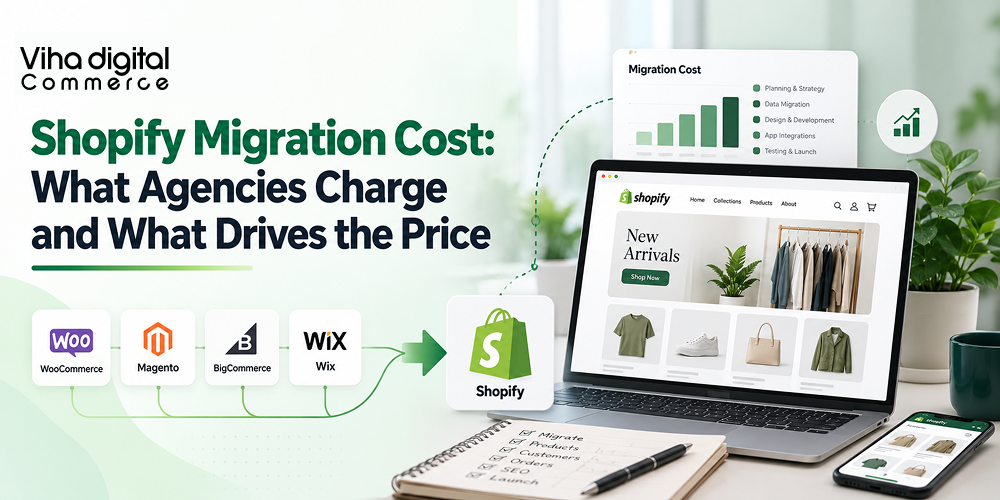
A Shopify migration moves a working business, and moving the product catalog is the easy part. Most bad decisions in this category start when a buyer pictures a data transfer and gets quoted for one. A complete migration has at least eight workstreams, and each can damage revenue if it goes wrong.
- Data migration. Products, variants, collections, customers, order history, gift card balances, reviews, blog content and metadata all need mapping to Shopify’s data model. Fields rarely line up neatly. Years of inconsistent data usually need cleaning before anything moves.
- SEO preservation. Shopify has its own URL structure, so most of your existing URLs will change. Every page that earns traffic needs a correct redirect, and titles, meta descriptions, structured data and internal links all need to carry over.
- Theme and storefront. Your design has to be rebuilt or adapted for Shopify’s theme architecture, and it must stay fast on mobile. Anything customers relied on in the old store needs an equivalent in the new one.
- Custom functionality. Bundles, subscriptions, B2B pricing, loyalty programs, product configurators and tiered discounts rarely transfer directly. Each one means choosing an app, writing custom code or changing the process.
- Integrations. ERP, inventory, shipping, tax, accounting, CRM, email marketing and customer support tools all exchange data with your store. If one sync fails quietly, you may oversell stock or lose orders before anyone notices.
- Payments and compliance. Gateways, fraud rules, tax settings, privacy obligations and customer consent records need careful handling. Passwords generally can’t be moved, so customers also need a clear way to reactivate their accounts.
- Testing. Real orders, refunds, discount combinations, tax cases, mobile devices, browsers and third-party syncs all need testing under realistic conditions, using a written plan.
- Launch and stabilization. The final data sync, DNS change, redirect activation and analytics checks need to be sequenced. The weeks after launch then need close monitoring, because that is when hidden problems tend to appear.
Read that list again and picture one person doing all of it. A freelancer would need to be a data specialist, an SEO strategist, a front-end developer, a back-end integrator, a QA tester and a project manager, while also running a business and serving other clients.
Some freelancers do cover most of this ground. They are also rare and heavily booked, and they often price closer to agencies than buyers expect. The bargain quote usually means something on the list has been left out, and the buyer may not find out which item until after launch.
Freelancer vs. agency pricing: why the gap is so wide
Freelancers commonly charge about $1,500 to $15,000 for a Shopify migration, while specialist agencies charge about $8,000 to $75,000. Two 2026 market guides, from Ringly and Viha Digital commerce, give the ranges below. Both publishers sell into this market, so treat the figures as directional. Your catalog, integrations and SEO footprint will move your number.
| Provider | Typical project price (USD) | Typical timeline | Usual fit |
| Freelancer or small studio | $1,500 to $15,000 | 2 to 8 weeks | Clean data, standard apps, simple catalog, limited search traffic |
| Specialist agency | $8,000 to $75,000 | 6 to 16 weeks | Mid-size stores with integrations, custom design and valuable organic traffic |
| Enterprise or Shopify Plus partner | $25,000 to $350,000+ | 3 to 9 months or more | Large, B2B, multi-region or heavily integrated businesses |
The gap comes mostly from a difference in scope. DigitalSuits makes the same point: wide quote differences usually reflect different amounts of work. It also notes that quotes under about $2,000 tend to cover data transfer alone, with redirects, integrations and post-launch testing billed separately or skipped.
A low quote and a high quote can therefore carry the same title, “Shopify migration”, while describing two different projects. Before comparing any two numbers, compare what each one includes.
What the agency’s price pays for
Agency pricing can look inflated until you break it into its parts. Each cost below exists to prevent a specific failure, or to fix one quickly.
A complete team. Your project draws on a project manager, solution architect, developers, designer, SEO specialist and QA tester. You pay for several specialists, each working on the part they know best. That costs more than one person’s hours because it is more than one person.
Discovery before the build. Serious agencies audit your data, apps, integrations and traffic before committing to a scope. Ringly reports that good agencies often charge $4,000 to $8,000 for about two weeks of discovery, and it warns that a large quote without this stage is largely guesswork. Paying for discovery is how you avoid paying for surprises.
Dedicated quality assurance. A developer testing their own work tends to confirm what they expect to see. A separate tester follows a written plan across devices, payment methods, discount rules and integrations, and goes looking for failures.
SEO protection. Redirect mapping, metadata transfer and post-launch monitoring take real specialist time. DigitalSuits estimates this work at $5,000 to $20,000 when bought separately, and notes it rarely appears in bare-bones quotes.
Redundancy. Agencies carry enough people to cover illness, resignations and overlapping deadlines. Salaries for that spare capacity show up in the price, and you benefit from them on the day someone is unavailable.
Tools and process. Staging environments, crawlers, migration scripts, ticketing, version control, security controls and documentation all cost money to buy and maintain. Each completed project also feeds the checklists used on the next one.
Business accountability. Contracts, insurance, legal review, data-handling policies and account management are overhead. They also mean a company stands behind the work, with a reputation it needs to protect.
Post-launch stabilization. Reputable agencies stay on after go-live to fix issues as real traffic and orders arrive. Ask for this period in writing, because cover varies by contract.
Where a typical agency budget goes
Ringly breaks a typical $25,000 mid-market project into the shares below. They overlap as ranges, and they show that data transfer is only a modest part of the job.
| Workstream | Share of budget | Risk it manages |
| Theme and design | 20% to 40% | Lower conversion, poor mobile experience |
| Custom development | 20% to 40% | Lost features, fragile workarounds |
| Data migration | 10% to 20% | Missing or corrupted records |
| Apps and integrations | 10% to 15% | Failed syncs, overselling, lost orders |
| Base setup and configuration | 5% to 15% | Payment, tax and shipping errors |
| SEO setup | 5% to 10% | Lost rankings and organic revenue |
| Post-launch retainer | 5% to 15% | Slow fixes during the riskiest weeks |
| Training and documentation | 2% to 5% | Dependence on the vendor for routine tasks |
Why freelancers can charge less
Freelancers charge less for legitimate reasons, including lower overhead, no sales team and no office. Some of that saving really is efficiency, and a good freelancer deserves credit for it.
The rest of the savings comes from moving work and risk onto you. Project management becomes your job. Testing may become your job. If the freelancer disappears, or an unforeseen issue needs skills they lack, solving it becomes your job too. The lower price is real, but you still carry the cost of everything it leaves out.
12 freelancer challenges that become agency benefits
Most freelancer risks come from structure, so they apply even when the individual is skilled and honest. An agency’s value lies in the systems built to remove those risks. Here are the twelve that matter most.
1. Single point of failure becomes built-in continuity
The freelancer challenge: Your whole project lives in one person’s head and on one person’s calendar. Illness, a family emergency, a better-paying contract or plain burnout can stop work overnight. Handing a half-finished migration to someone new is slow, because they have to reverse-engineer decisions nobody wrote down.
The agency benefit: An agency assigns a team and keeps project knowledge in shared systems. If a developer leaves mid-project, another can pick up the tickets, code and documentation. Your launch date stops depending on one person’s circumstances.
2. Limited skill range becomes specialists on every workstream
The freelancer challenge: A developer who writes excellent theme code may know little about redirect strategy, ERP data flows or tax configuration. Nobody excels at everything. The weakest area usually gets the least attention, and it is often the one a client can’t easily check.
The agency benefit: Each workstream goes to someone who does that work every day. The SEO specialist handles the redirect map, the integration engineer handles syncs, and the designer handles the customer experience. Senior staff can also review junior work, so mistakes get caught before they reach your store.
3. SEO risk becomes protected organic revenue
The freelancer challenge: SEO is the line item most likely to shrink in a cheap quote, and the damage stays invisible until after launch. Redirect failures can be severe. The Ringly guide cites research that botched redirects can cost 30% to 50% of organic traffic, with recovery taking up to a year. DigitalSuits puts the routine range at 20% to 50% within weeks.
The agency benefit: A strong agency treats SEO as its own workstream. It crawls the existing site, benchmarks rankings, maps redirects page by page, preserves metadata and structured data, and tests everything on staging. After launch, it monitors crawl errors and traffic so it can catch problems early. For a store that relies on organic sales, this work alone can justify the fee.
4. Data errors become clean, verified records
The freelancer challenge: Migration tools can move data, but they can’t judge whether it is right. Variants lose their mapping, customer tags vanish, tax-exempt flags disappear and old orders arrive incomplete. Many of these errors surface only when a customer complains or the finance team tries to reconcile the books.
The agency benefit: Agencies audit and clean data before moving it, then run trial migrations and reconcile the results against the source. That preparation is substantial. Ringly describes one mid-size fashion migration where cleanup ran for six weeks and took 30% of the project cost. An agency scopes this work upfront, so it doesn’t arrive as a surprise halfway through.
5. Integration gaps become a connected operation
The freelancer challenge: Connecting Shopify to an ERP, warehouse, CRM or subscription system calls for back-end and architecture experience. Sync logic also needs to handle failures, retries and duplicates. A connection that passes a quick test can still fail on a busy sales day, leaving you with oversold stock and orders nobody fulfilled.
The agency benefit: Agencies design integrations as a system, working out which platform owns each piece of data and what should happen when a sync fails. They test with realistic volumes and add monitoring. Having connected similar systems before, they can also tell you when an existing app is a better answer than custom code.
6. Self-testing becomes independent quality assurance
The freelancer challenge: Most freelancers test their own work, usually under time pressure at the end of the project. Author blindness is real, and it affects everyone. Checking a few product pages and placing one test order leaves discount stacking, partial refunds, international tax and older mobile browsers largely unexamined.
The agency benefit: Independent testers work through a written test plan on a staging store, and every defect is logged, fixed and rechecked. You also get structured user acceptance testing, so your team can sign off on real workflows. Most checkout bugs get found before a customer can find them.
7. Patchy communication becomes managed delivery
The freelancer challenge: A solo operator is also the salesperson, accountant and support desk, and may be serving several other clients. Replies can slow as the deadline nears, which is exactly when you most need them. Time-zone gaps can widen the problem. Meanwhile, someone on your team ends up acting as an unpaid project manager.
The agency benefit: A dedicated project manager owns the plan, timeline, risks and dependencies. You get regular status updates, one clear point of contact and an escalation route when something slips. Your team can stay focused on running the business during the move.
8. Unclear scope becomes predictable budgeting
The freelancer challenge: Low quotes often rest on assumptions nobody has tested. When an unexpected requirement surfaces in week five, you face an extra invoice, a reduced feature set or a stalled project. By then you have too much invested to walk away easily, so the cheap quote keeps growing.
The agency benefit: Paid discovery exposes complexity before the build begins. The resulting scope lists deliverables, exclusions, assumptions and a formal change process. Changes can still happen, and Ringly advises budgeting a 15% to 20% contingency on agency projects too. The difference is that you see them coming and can decide with the numbers in front of you.
9. Capacity limits become reliable timelines
The freelancer challenge: One person has a fixed number of hours, and a single overrunning client can push your project back. Work that could run in parallel, such as theme development, data preparation and integration builds, gets done in sequence. If your launch must land before peak season, that creates real risk.
The agency benefit: Agencies can run workstreams side by side and move people around when priorities change. They also plan launches backward from your trading calendar, keeping clear of your busiest periods. A missed launch window can cost more than the whole project, so this kind of planning has direct financial value.
10. Security exposure becomes controlled access
The freelancer challenge: A migration gives a vendor access to customer records, order histories, admin accounts and API keys. A solo contractor may have no formal policies for storing data, managing credentials or offboarding. You may also have little visibility into the security of their devices or any subcontractors they use.
The agency benefit: Established agencies can provide data-processing agreements, role-based access, secure credential storage and offboarding procedures. They can also answer your legal or procurement team’s questions in writing. If your business handles regulated data or sells across borders, that paperwork is often a requirement. Ask for it during vetting, since standards differ between agencies.
11. Limited recourse becomes real accountability
The freelancer challenge: If a project goes badly, your practical options may be limited, particularly when the contractor works in another country and the contract is thin. Someone without insurance or a team may lack the means to put a serious problem right, however much they want to.
The agency benefit: An agency is a registered business with contracts, leadership to escalate to and a reputation built on client references. Its future sales depend on projects going well. When something breaks, there is an organization responsible for fixing it, with the staff to do so.
12. Launch-day handoff becomes long-term support
The freelancer challenge: Many freelance engagements end at go-live, just as real customers begin finding the edge cases. Your fixes then compete with the freelancer’s next client. If the store relies on undocumented custom code, every future change may depend on finding that same person again.
The agency benefit: Agencies typically offer a stabilization period, followed by optional ongoing support. They hand over documentation and train your team, and they stay available for the problems that appear in the weeks after launch. Ringly estimates that the post-launch period lasts four to eight weeks, and a responsive team matters most during that time. The agency also knows your build, so it can move straight on to optimization and growth work.
The true cost: quote vs. total outcome
A freelancer wins on the invoice, and an agency usually wins once you count what can go wrong. The table below summarizes the structural differences.
| Factor | Freelancer | Certified agency |
| Upfront price | Lower | Higher |
| Team | One person, or informal subcontractors | Project manager, architect, developers, designer, SEO and QA |
| Continuity | Depends on one person | Team cover and shared documentation |
| Discovery | Often brief or skipped | Structured audit before the final scope |
| SEO | Varies, often an extra | Dedicated workstream in a full-service scope |
| Testing | Usually self-tested | Independent QA and user acceptance testing |
| Integrations | Best for simple connections | Designed, tested and monitored as a system |
| Security and compliance | Varies widely | Documented policies and agreements |
| Accountability | Individual, and sometimes hard to enforce | Company contract and escalation path |
| After launch | Often limited or ad hoc | Stabilization period and optional retainer |
A worked example
Take a hypothetical store with $3 million in annual revenue, 40% of it from organic search and a 40% gross margin. That works out to $100,000 in organic revenue each month. The figures below are illustrative assumptions, so replace them with your own.
| First-year cost | Freelancer path | Agency path |
| Project fee | $6,000 | $30,000 |
| Internal time managing the project | $6,000 (120 hours at $50) | $2,000 (40 hours at $50) |
| Post-launch fixes billed separately | $4,000 | Included in the agency fee |
| Lost margin from reduced organic traffic | $24,000 (20% dip for 3 months) | $2,000 (5% dip for 1 month) |
| Total | $40,000 | $34,000 |
In this scenario, the cheaper quote ends up costing $6,000 more, and the store also spends three months below its normal search performance. Nothing in the example assumes a catastrophe, such as a corrupted database or a failed peak-season launch.
The result depends on the risk showing up. If the freelancer’s migration causes no traffic loss, that path stays cheaper in cash terms. Choosing an agency is therefore a lot like buying insurance: you pay a known premium to limit a loss you can’t predict.
The useful question is how much revenue you would need to lose before the agency pays for itself. Here the $24,000 fee gap equals $60,000 of lost revenue at a 40% margin, which is a 20% organic dip for three months. Set that against the 20% to 50% traffic losses reported for botched redirects.
The math also gets more favorable as a store grows. Double the revenue and the potential loss doubles, while the agency’s fee usually rises far more slowly. Larger stores also tend to need the integrations and testing that a solo provider finds hardest to deliver.
What an agency-led migration looks like
A well-run agency migration moves through six stages, and each one ends with something you can review. This structure explains much of the timeline and the fee. It also gives you checkpoints, so problems surface while they are still cheap to fix.
- Discovery and audit. The team reviews your data, apps, integrations, custom features and search traffic. It benchmarks current performance and records your rankings, conversion rate and site speed. You receive a written scope, risk list and timeline.
- Architecture and planning. The team decides how each feature and data type will work in Shopify, and which system owns which data. Every existing app and custom feature is matched to an app, native function or custom build, or marked for retirement.
- Build on staging. Theme work, app setup and integration development take place away from your live store. Customers see no disruption, and your team can review progress as it happens.
- Trial migrations. The team runs test imports, then compares counts and samples against the source data. Each run improves the scripts, and the redirect map is checked against a crawl of the old site.
- Testing and sign-off. QA works through the test plan, and your team runs real workflows through user acceptance testing. Launch waits until the agreed criteria are met, so the date is based on evidence as well as the calendar.
- Launch and stabilization. The team runs the final data sync, switches the domain and activates redirects at a low-traffic time. It then watches orders, payments, integrations, search errors and analytics closely, fixing issues in priority order.
Compare that with the common low-cost sequence: import the data, install a theme, connect a few apps, check some pages and go live. In a very simple store, that can work. In a store with real complexity, every skipped step becomes a question you first hear about from a customer.
Five costs a low quote may leave out
A quote can be accurate and still incomplete. Ask each provider, freelancer or agency, whether these items are included, and get the answers in writing.
- Data cleanup. Duplicate customers, orphaned categories and inconsistent attributes need fixing before migration.
- Replacement apps. Features from your old store may become monthly app subscriptions, which belong in your first-year budget.
- Redirect mapping and monitoring. This work needs doing page by page, and monitoring continues after launch.
- Email authentication. Domain records for your sending tools need checking, or deliverability can suffer during the switch.
- Extra customer support. Password resets, unfamiliar order numbers and missing saved carts can raise contact volume in the weeks after launch.
None of these costs disappear when a quote leaves it out. It simply moves to a later invoice or to your own team.
Already holding a migration quote? Bring it to the team at Viha Digital Commerce, and we’ll go through what it covers, what it leaves out and where your store carries the most risk.
When a freelancer is the right choice
A freelancer can be the sensible option when the store is small and little revenue is at risk. Paying agency rates in these cases would be overkill. A good agency will often tell you so.
A freelancer may be a good fit if most of these are true:
- Your catalog is small and simple, and the data is already clean.
- You have no ERP or other complex integrations, and standard apps cover your needs.
- Organic search brings in little of your revenue.
- A short disruption would be survivable.
- Someone on your team has the time and knowledge to manage the project and test the work.
Once the store starts to depend on organic traffic, connected systems or a firm launch date, the balance shifts. If you can’t afford to find out what the cheap quote left out, the agency is the safer buy.
How to choose the right certified agency
A high price doesn’t guarantee a good result, so vet agencies as carefully as you would vet a freelancer. Start with their standing in the Shopify Partner Program, and then look for evidence of actual migration work.
Shopify’s program is changing. From January 1, 2027, service partners will sit in Silver, Gold, Platinum or Diamond tiers, based on the sales volume and number of stores attributed to them. Gold, for example, requires $5 million in attributed sales and five attributed shops over four years. The Select, Plus and Premier tiers retire on that date.
A tier is useful evidence of delivery volume, but it doesn’t measure the quality of any one project. Treat it as a filter for your shortlist, then use these questions to make the decision:
- How many migrations like ours have you completed? Ask for examples with a similar catalog size, business model and integration load.
- Can we speak with past migration clients? Ask them what went wrong and how the agency responded, since every project hits problems.
- What happened to traffic after launch? Ask for before-and-after organic data on real projects, including timeframes.
- Who will actually work on our project? Meet the project lead, and ask which roles are in-house and which are subcontracted.
- What credentials does the team hold? Ask which staff hold current Shopify credentials and how those skills apply to your project.
- What does your discovery phase produce? Expect a written audit, a scope, a risk list and a timeline you can review before committing to the build.
- How do you handle redirects and SEO validation? A strong answer covers crawling, page-level mapping, staging tests and monitoring after launch.
- What does your QA plan cover? Ask to see a sample test plan and how defects are tracked.
- What are the rollback and launch plans? The team should be able to explain the final sync, the cutover sequence and what happens if something fails.
- What post-launch support is included? Get the length, response times and covered issues in the contract.
- Who owns the code and accounts? Your business should own its store, data, code, domains and app accounts.
- How do you manage data security? Ask for the access policy, data-processing terms and offboarding process.
Watch for a few warning signs: a fixed price offered before anyone has looked at your data, vague answers about SEO, no named project lead and pressure to sign quickly. An agency that asks hard questions early is usually one that takes your launch seriously.
Why brands choose Viha Digital Commerce for Shopify migration
Viha Digital Commerce gives growing brands the certified, team-based migration support this guide recommends. We are a certified Shopify Plus Partner, founded in 2015, with offices in Ahmedabad and New York. Our team of 85+ specialists has served clients in more than 25 countries.
Here is how that answers the risks covered above:
- One team across the project. UI/UX design, development, project management, QA and digital marketing sit under one roof, so you aren’t coordinating separate vendors.
- SEO as part of the job. Ecommerce SEO is one of our core services, which keeps your search visibility in the conversation from the start.
- Connected systems. We build and test the third-party integrations your store relies on to keep running.
- Support after launch. We can stay on through maintenance and support once your store is live, so you have a team that already knows your build.
- Client feedback you can check. We hold a 4.8 out of 5 rating across 35 reviews on Clutch as of November 2026, and you can read those reviews yourself.
We also welcome the twelve questions above. Put them to us as you would to any other agency, and compare our answers side by side.
Frequently asked questions
Why do agencies charge so much more than freelancers for a Shopify migration?
Agencies usually quote for a broader scope and a whole team. The fee covers discovery, project management, specialist development, SEO, independent testing and post-launch support, along with the business systems behind them. A freelancer’s lower quote often covers less of that work, and the rest falls to you.
Are freelancers less skilled than agency developers?
No. Many freelancers are excellent developers. The limits are structural: one person has finite hours, limited cover and a narrower range of specialties than a team.
Can a freelancer handle SEO during a migration?
Some can, especially in smaller stores. Ask to see their process and before-and-after traffic data. Check that the redirect map, metadata transfer and post-launch monitoring are named in the scope, since these are easy to leave out of a low quote.
How long does an agency migration take?
Specialist agency projects commonly run 6 to 16 weeks, and enterprise projects can run for 3 to 9 months or longer. Your catalog, integrations and custom features will set the real timeline. Leave enough room to finish well before your busiest season.
Is a higher-tier agency always better?
Not always. A partner tier reflects a track record of launched stores and sales volume. A smaller certified agency with deep migration experience in your category may suit you better than a larger one focused on other work.
Could I hire a freelancer and an agency together?
Yes, and it can work well once the migration is complete. Many brands use an agency for the high-risk migration, then bring in a trusted freelancer for smaller updates. Clear documentation makes that handover easier.
Conclusion: pay for the outcome
For most established stores, the certified shopify development agency is the better investment because it reduces the risks that cost the most. Its price reflects a full team, tested processes, specialist coverage and a company that stays accountable after launch.
A freelancer can do fine work, and in a small, simple store that may be all you need. Once your store relies on search traffic, connected systems and uninterrupted sales, the migration deserves more than a single point of failure.
So when you compare quotes, set the totals aside for a moment. Ask what each one includes, who will do the work, what happens if something fails and who will be there the week after launch. The answers will show which quote is actually the cheaper one.
Ready to plan your move to Shopify?
Your migration should leave your rankings, data and revenue in safe hands. Tell us about your store, your current setup and your target launch date, and we’ll help you work out the right scope.








 All-in-One Solution
 Customizable Services
 Assortment of Payment Options
 Optimized Sales Processes
 Omnichannel Maintenance & Support
 Custom Shopping Cart
 Advanced Security & Support
 API Payment & Logistic Integrations
 Social Media Integration
 Professional Communication
 Skilled Developers
 Timing is Everything
 Secure Agreements
 Support Tilt
 Quality Top Up Most
 White Development Pathway
 Competitive Price Point