
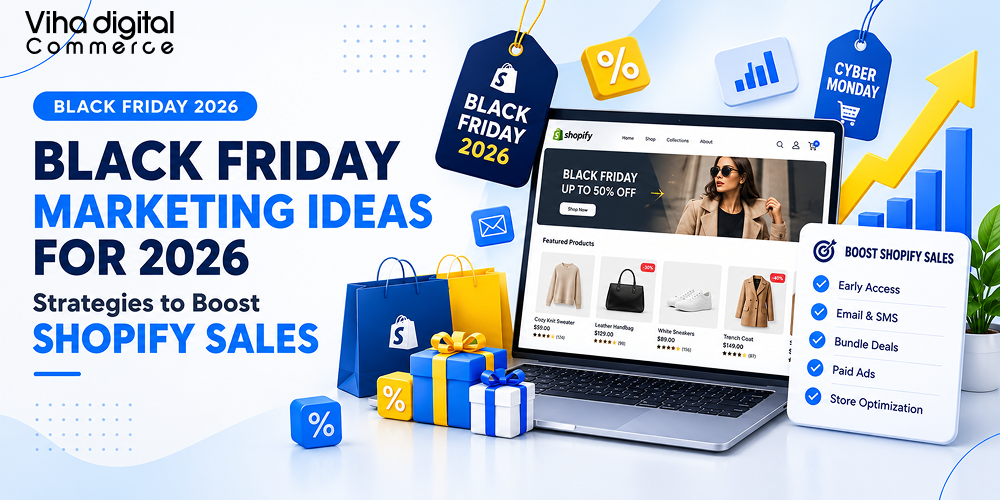
Black Friday Marketing Ideas for 2026: Strategies to Boost Shopify Sales
Key Takeaways
- Black Friday 2026 falls on Friday, November 27, with Cyber Monday on November 30. If you are reading this in late October, you have roughly four weeks, which is enough time to run a strong campaign if you prioritise.
- The best Black Friday marketing ideas combine a clear offer, a fast store, owned channels (email and SMS), disciplined paid media and flawless fulfilment, not discounts alone.
- You can increase ecommerce sales without offering huge discounts by using bundles, gifts with purchase, tiered spend rewards, early access, free shipping thresholds and scarcity that is real.
- Speed, stock accuracy and checkout reliability decide more Black Friday revenue than creative does. A slow or broken store wastes every dollar of traffic you buy.
- Do the margin maths first. A 30 percent discount can require three times the unit volume just to earn the same profit.
- Shopify Plus adds checkout customisation, Launchpad scheduling, Shopify Functions, higher automation limits and expansion stores that help at peak volume, but a well-prepared standard store can still win.
Quick Answer: What Are the Best Black Friday Marketing Ideas for 2026?
The best Black Friday marketing ideas for 2026 are:
- Early access: Run a VIP sale for email and SMS subscribers before the public event.
- Landing page: Build a dedicated Black Friday page at an evergreen URL you reuse every year.
- Smarter offers: Use bundles, gifts with purchase and tiered rewards instead of only blanket discounts.
- Paid media: Run a tight ad structure with proven creative and a clean product feed.
- Store readiness: Harden speed, inventory sync and checkout before traffic arrives.
- Automated flows: Capture every visitor with abandoned cart, browse and post-purchase flows.
- Shipping and support: Set clear shipping cut-offs and support rules so conversion holds up in the rush.
- Profit tracking: Measure contribution margin, not just revenue, so a big sales day doesn’t become a loss.
This guide from Viha Digital Commerce walks through the full plan: strategy, offers, landing page build, store optimisation, technical performance work, email, SMS, ads, organic and AI-search visibility, operations, compliance and post-event retention, with the technical details that most Black Friday articles leave out.
The 2026 Black Friday Calendar and Four-Week Sprint
Black Friday is no longer a single day. Shoppers start comparing deals in early November, many brands run week-long events, and demand continues through Cyber Monday and into the holiday shipping window. Here are the key dates for 2026:
| Date | Event | What it means for your store |
| Thursday, Nov 26 | Thanksgiving (US) | Strong evening mobile traffic; many brands go live here or earlier |
| Friday, Nov 27 | Black Friday | Peak in-store and online demand; heaviest ad competition |
| Saturday, Nov 28 | Small Business Saturday (US) | Opportunity for independent and local-brand storytelling |
| Sunday, Nov 29 | Weekend extension | Often strong for email re-engagement and gift shoppers |
| Monday, Nov 30 | Cyber Monday | Peak online-only shopping; strong for electronics, fashion and gifts |
| Tuesday, Dec 1 | Giving Tuesday | Cause-led campaigns and charitable bundles |
A four-week countdown from today
If you are starting from Nov 4, use this schedule. Compress or expand it to suit your team size.
| Window | Focus | Key deliverables |
| Nov 4 to Nov 7 | Strategy and offer lock | Margin model, offer ladder, inventory plan, creative brief, tracking audit |
| Nov 8 to Nov 13 | Build | Landing page, collections, email and SMS flows, product feed, discount setup |
| Nov 14 to Nov 18 | Test and warm up | Load and speed tests, checkout tests, email warm-up, waitlist campaign, retargeting pools |
| Nov 19 to Nov 25 | Teaser and early access | VIP early access, ad creative testing, support macros, final QA, code freeze |
| Nov 26 to Nov 30 | Live event | Monitoring, budget pacing, stock control, quick creative swaps |
| Dec 1 onward | Post-event | Order fulfilment, win-back flows, reviews, lessons learned |
A code freeze is vital. Set a date, for example November 23, after which no non-essential theme or app changes go live. Most Black Friday outages are caused by last-minute changes, not by traffic itself.
Set goals before you set discounts
Decide what success means. Common goals include revenue, new customer acquisition, list growth, clearing excess stock and raising customer lifetime value. These pull in different directions. A list-building goal favours a strong early-access offer. An inventory-clearance goal favours deeper discounts on specific SKUs. A profit goal favours bundles and gifts. Write down two or three measurable targets, for example net new customers, blended marketing efficiency ratio (MER) and contribution margin per order, and make every decision against them.
How to Prepare a Shopify Store for Black Friday 2026
Preparation separates stores that capitalise on traffic from stores that merely receive it. Use this checklist as the backbone of your plan.
Business and offer readiness
- Lock your offer ladder (see sections 3 and 4) and the exact start and end times, including time zone.
- Build your margin model by SKU, including product cost, shipping, payment fees, returns allowance and expected ad cost.
- Choose hero products, secondary products and products you will not discount.
- Create a creative and messaging plan: one big idea, several angles, and assets for every channel.
- Confirm supplier lead times and last order dates, especially if you dropship or rely on overseas stock.
Store readiness
- Audit apps and remove anything you do not need. Every app adds scripts and risk.
- Run speed tests on home, collection, product, cart and landing pages on mobile.
- Test checkout with every payment method, shipping option, discount type and currency you support.
- Verify tax settings and shipping rates for every market.
- Check mobile usability: tap targets, sticky buttons, form fields, pop-ups.
- Review stock levels and the Continue selling when out of stock setting per product to avoid oversells.
Tracking readiness
- Confirm GA4 events (view_item, add_to_cart, begin_checkout, purchase) fire correctly and deduplicate.
- Verify Meta Pixel plus Conversions API, TikTok Pixel plus Events API and Google Ads conversion tracking, including enhanced conversions.
- Tag all campaign URLs with consistent UTM parameters.
- Build a live dashboard (Shopify Analytics, GA4 or a BI tool) showing sessions, conversion rate, AOV, revenue, orders, discount usage, stock for hero SKUs and ad spend.
People and process readiness
- Assign an owner for each channel and an incident lead.
- Prepare a runbook: what to do if the site slows, a discount code fails, an item sells out or an ad account is restricted.
- Schedule coverage for the event weekend, including support, ads and development.
- Prepare customer support macros for shipping cut-offs, returns, order edits and promotion questions.
Do the margin maths first
Most stores underestimate how much extra volume a discount requires. Use this simple formula:
Required volume increase = Current contribution per unit ÷ (Current contribution per unit − Discount per unit)
Example: a product sells for $100, with $40 product cost and $15 for shipping, fees and returns allowance. Contribution is $45.
| Discount | Sale price | Contribution per unit | Volume needed to match normal profit |
| 10% | $90 | $35 | 1.29x (29% more units) |
| 20% | $80 | $25 | 1.80x (80% more units) |
| 30% | $70 | $15 | 3.00x (200% more units) |
| 40% | $60 | $5 | 9.00x (800% more units) |
This is before ad costs, which usually rise during Black Friday. It is why smart merchants discount selectively, use bundles and gifts, and protect margin on best sellers. If a 30 percent discount only attracts the same shoppers who would have bought anyway, you have simply given away profit.
Black Friday Sales Ideas and Promotion Ideas That Protect Margin
What are the best Black Friday promotions for ecommerce stores? The answer depends on margin, audience and goals, but the strongest ones share a clear message and a reason to act now. Here is a menu of Black Friday promotion ideas, with guidance on when each works best.
The offer ladder
Structure your event in stages so each audience gets a reason to buy:
- Waitlist and teaser (early November): collect emails and SMS opt-ins with the promise of early access or a surprise gift.
- VIP early access (Nov 23 to 25 or Nov 25 evening): your best customers and subscribers shop first, which rewards loyalty and smooths demand.
- Black Friday launch (Nov 26 evening or Nov 27 morning): your headline offer opens to everyone.
- Weekend extension (Nov 28 to 29): a new offer or product drop for people who missed the first wave.
- Cyber Monday (Nov 30): a fresh angle, such as a flash sale on a category or a last-chance reminder.
- Extended or Giving Tuesday (Dec 1): a cause-led offer or final call before holiday shipping cut-offs.
Promotion types that work
| Promotion | How it works | Best for | Watch out for |
| Site-wide percentage off | Single discount across catalogue | High margin, clearance, simple messaging | Erodes margin, trains customers to wait |
| Tiered spend discount | Spend more, save more (for example $100 gets 10 percent, $200 gets 15 percent) | Raising AOV | Needs clear on-site progress messaging |
| Bundle offers | Curated sets at a combined price | Increasing AOV and moving slow items | Inventory complexity |
| Buy X, get Y | Free or discounted add-on | Introducing new products, clearing stock | Discount stacking conflicts |
| Gift with purchase (GWP) | Free item above a spend threshold | Preserving perceived price, margin protection | Gift stock, cost of gift |
| Free shipping threshold | Free shipping above a set cart value | Raising AOV | Shipping cost modelling |
| Early access for subscribers | Exclusive window before public | List growth, loyalty | Fairness to other customers, clear communication |
| Doorbuster | Deep discount on one limited item | Traffic and acquisition | Limited quantity, strict purchase limits |
| Mystery or surprise discount | Reveal reward after email or SMS signup | List growth | Must be fair and legally clear |
| Store credit or bonus card | Spend now, get credit for January | Repeat purchases | Accounting and expiration rules |
| Flash sales | Short time-boxed offers | Urgency, mobile impulse | Real deadlines only |
| Charity tie-in | Percentage of sales to a cause | Brand-led audiences, Giving Tuesday | Transparent claims |
| Pre-sale for new collections | Reserve before launch | Limited editions | Delivery timelines |
Choose offers by business type
- Fashion and beauty: bundles, GWP with travel sizes, tiered discounts, early access for loyalty members.
- Electronics and gadgets: doorbusters on hero products, accessory bundles, extended warranties.
- Home and lifestyle: gift sets, tiered spend, free shipping thresholds.
- Consumables and subscriptions: subscribe-and-save upgrades, multi-pack discounts, free first-box gifts.
- Dropshipping stores: emphasise reliable delivery estimates, bundles and value-adds rather than depth of discount, since supplier margins are thin.
- B2B and wholesale: volume pricing, restock incentives and gated early access for existing accounts.
Messaging principles
- Lead with the benefit and the end date, not the percentage alone.
- Be specific: save $40 on the bundle beats big savings.
- Use real scarcity (true stock limits, true deadlines) and show how many remain only if the number is accurate.
- Repeat the offer consistently on the announcement bar, hero banner, product pages, cart and emails.
How to Increase Ecommerce Sales Without Offering Huge Discounts
Deep discounts are not the only way to win. Many brands prefer to protect their pricing and still capture Black Friday demand. Here are tactics that raise revenue and profit without heavy markdowns.
Raise average order value
- Bundles and kits: combine complementary products at a modest saving. Name them by use case (starter kit, gift set).
- Tiered rewards: unlock a gift or free shipping at a higher spend, with a progress bar in the cart.
- Post-purchase upsells: a one-click offer on the thank-you page, using checkout and order status extensions where available.
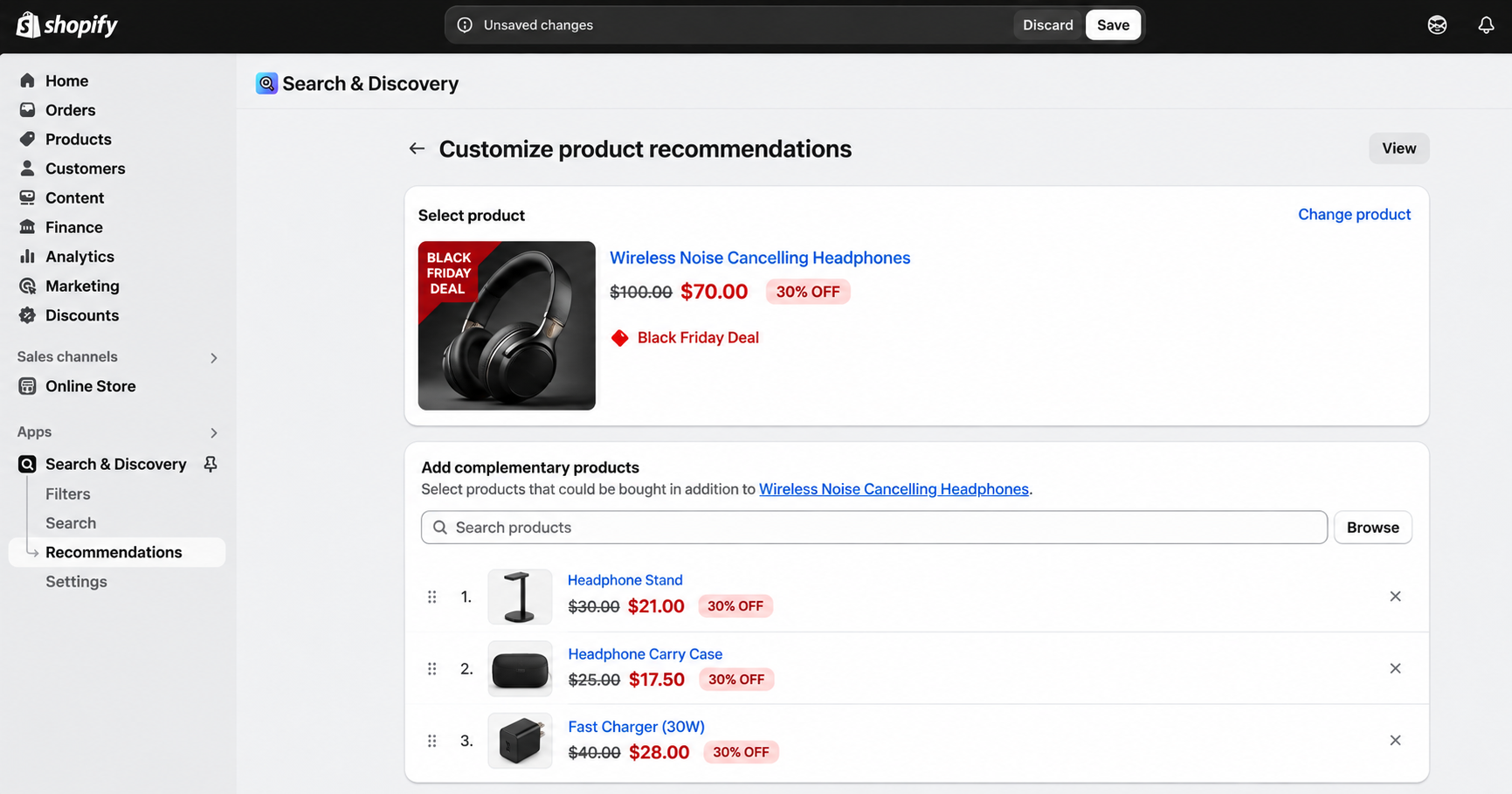
- Cross-sells on product and cart pages: use Shopify’s product recommendations, the Search & Discovery app or a trusted app.
- Quantity breaks: buy two, save a little; buy three, save more, which lifts unit volume on consumables.
Add value instead of cutting price
- Gift with purchase: a high perceived-value, low-cost item protects margin better than a percentage off.
- Extended returns: a longer returns window for holiday gifts reduces purchase anxiety.
- Free gift wrap, engraving or personalised notes: valued by gift buyers.
- Free expedited shipping on orders above a threshold.
- Loyalty point multipliers: double points days reward customers without lowering prices.
- Exclusive colourways or limited editions that are not discounted.
Use payment flexibility
Buy now, pay later options such as Shop Pay Installments (where available), Klarna or Afterpay can lift conversion on higher-ticket items by easing affordability, without touching price. Confirm availability and fees for your region and plan.
Reduce friction instead of price
Often, a one-percentage-point conversion gain beats a ten-percent discount. Fix mobile checkout speed, enable accelerated checkouts (Shop Pay, Apple Pay, Google Pay), clarify shipping costs and delivery dates on the product page, and show trust signals such as reviews and returns policy.
Segment your offers
Give your best customers early access and richer perks, and give new customers a first-purchase incentive. Keep your broadest discount for the audiences who need it most, such as lapsed customers or cart abandoners. This protects margin from shoppers who would have paid full price.
Run a Black Friday “moment”, not just a markdown
Build a story: a limited drop, a founder note, a behind-the-scenes video, a charity partnership, a customer-voted bundle. Brands that give people a reason to care often need smaller discounts.
How to Create a Black Friday Landing Page on Shopify
A dedicated landing page is the hub of your campaign. Ads, emails, SMS and social posts all point to it, so it must be fast, clear and consistent.
Planning the page
- Use one evergreen URL, for example /pages/black-friday or /collections/black-friday, and reuse it every year. Search engines accumulate authority on a stable URL, and you avoid fresh redirects and broken links.
- Decide whether it should be a page or a collection. A collection page makes the grid of products easy to filter and sort and supports automatic updates. A page built with sections lets you design a richer story. Many stores use a page for the hero and story, with embedded collection sections below.
- Plan for phases. The same URL can show a waitlist before launch, an early-access view for subscribers, the full offer on Black Friday and a Cyber Monday message later.
Building it in the theme editor
If your theme supports Online Store 2.0, you can build this without code:
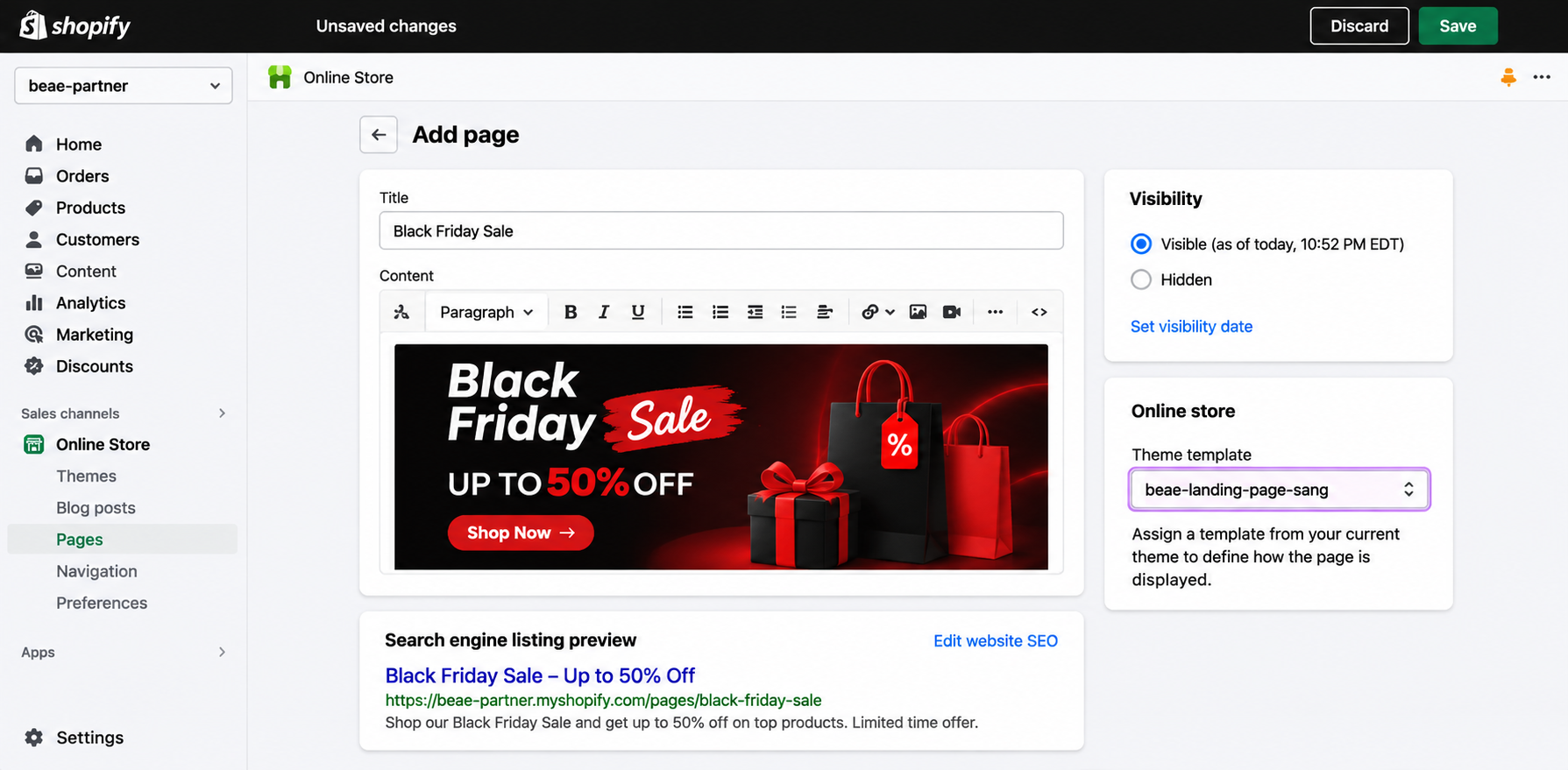
- In Shopify admin, go to Online Store > Themes > Customize.
- Add a new template (for example page.black-friday) by clicking the page template selector, then Create template.
- Add sections in this order: hero banner with offer and end date, countdown (optional), featured collection of doorbusters, bundles section, tiered offer explainer, category links, social proof (reviews and press), FAQ, email and SMS signup.
- Create a page in Online Store > Pages, name it Black Friday, and assign your new template.
- Add the page to navigation, the announcement bar and the footer.
- Preview on mobile and desktop and test every link.
Technical elements that make the page work
- Collections for deals: create smart (automated) collections using tags such as bf2026-doorbuster and bf2026-bundle. Tagging products lets you add or remove items without editing the page.
- Metafields for deal details: use product metafields (for example custom.bf_badge, custom.bf_end_date) to drive badges and labels in your theme. This keeps content in structured data and out of hard-coded templates.
- Automatic discounts: create automatic discounts in Discounts so shoppers do not need codes. Check combination rules for product, order and shipping discounts to prevent unwanted stacking.
- Discount codes for channel-specific offers: use unique codes for email, SMS and influencers to track attribution and prevent leakage.
- Price display: use Shopify’s compare-at price so sale prices show correctly. Make sure the compare-at price reflects a genuine previous selling price (see the compliance section).
- Image and video weight: compress the hero, use responsive srcset, and avoid autoplaying heavy video above the fold on mobile.
- Accessibility: ensure sufficient contrast on sale badges, keyboard-operable timers and descriptive alt text.
An example of date-gated announcement bar logic
Developers can use Liquid to show different messages by date, so you do not have to publish changes at midnight. The example below compares the current time with a start and end timestamp. Always confirm time zone behaviour, since Liquid’s now uses the shop’s time zone settings and timestamps need to account for that.
{% assign now_ts = ‘now’ | date: ‘%s’ | plus: 0 %}
{% assign bf_start = ‘2026-11-26 18:00:00’ | date: ‘%s’ | plus: 0 %}
{% assign bf_end = ‘2026-12-01 23:59:00’ | date: ‘%s’ | plus: 0 %}
{% if now_ts >= bf_start and now_ts <= bf_end %}
Black Friday is live: bundles and gifts on best sellers. Ends Dec 1.
{% elsif now_ts < bf_start %}
Join the VIP list for early access.
{% endif %}
This kind of date logic works for static pages, but pages cached for long periods or custom sections can behave unexpectedly, so always test on a preview theme. For simple needs, scheduling a theme with Shopify Plus Launchpad or manually publishing at a set time is safer.
Countdown timers: use them honestly
A countdown timer can add urgency, but it must reflect a real deadline for every visitor. Evergreen timers that reset on each visit can break consumer protection rules in several markets and damage trust. Tie timers to a fixed end time stored in a theme setting or metafield.
SEO for the landing page
- Use a clear title tag such as Black Friday Deals 2026 | Brand Name, and update the year each season while keeping the URL fixed.
- Write unique on-page copy rather than only a product grid. Include the offer, dates, shipping cut-offs, returns policy and FAQs.
- Link to the page from the home page, navigation and relevant collections for internal link equity.
- Add FAQPage and Offer structured data where appropriate, with accurate priceValidUntil dates.
- Do not noindex the page. Keep it live after the event with an “event ended, join the list for next year” message so it retains authority.
How to Customize a Shopify Store for Black Friday Promotions
How do you customize a Shopify store for Black Friday promotions without breaking it? Focus on high-impact, low-risk changes and stage everything on a preview theme.
High-impact customisations
| Area | Customisation | Why it helps |
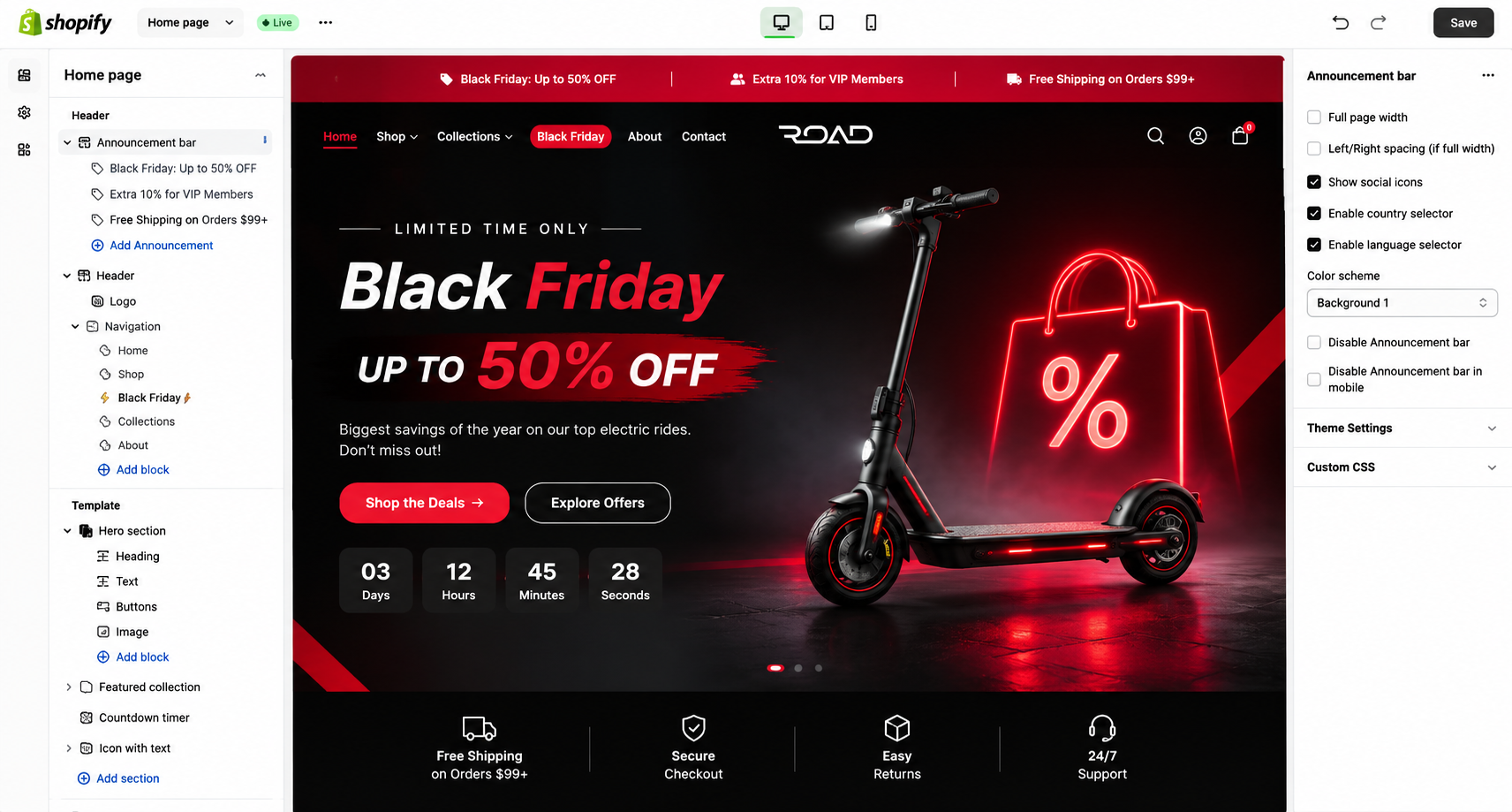
| Announcement bar | Offer, end date, link to landing page | Visible on every page |
| Home page hero | Single clear offer with a button to the landing page | Focuses attention |
| Navigation | Add a Black Friday link, optionally highlighted | Easy discovery |
| Collection pages | Sale badges, sort by best selling, filters for deal types | Faster product discovery |
| Product cards | Badges for percentage off, bundle or limited stock | Quick signal of value |
| Product page | Offer reminder near the add-to-cart button, delivery estimate, shipping cut-off | Reduces hesitation |
| Cart | Free shipping or gift progress bar, add-on suggestions | Raises AOV |
| Pop-ups | One timed, mobile-friendly signup prompt | Builds your list without blocking shoppers |
| Search | Synonyms and boosts for deal terms | Helps intent-driven visitors |
| Footer | Shipping cut-offs, returns policy, support hours | Reassurance |
Use theme settings and metafields so marketing can edit
Rather than editing code for every banner change, add theme settings or sections for the announcement text, link, colour and end date. This keeps merchants in control and cuts risk during the event. If your theme does not support this, our Shopify theme customization services can add editable sections and metafield-driven badges so your team can launch and update offers safely.
Design for mobile first
Most Black Friday ecommerce traffic arrives on phones. Check that offer text is legible without zooming, add-to-cart buttons are within thumb reach, sticky bars do not cover content, and forms use the correct input types for fast autofill. Test on real mid-range devices, not just a high-end phone.
Prepare a deal-ready product page template
Create an alternate product template for Black Friday items with an offer module under the price, a visible delivery estimate, an inline returns summary, a section for bundle upsells and a short FAQ. Assign it to products by template suffix, so you can switch products on and off easily and revert after the event.
Store optimisation checklist for conversion
Shopify store optimisation before Black Friday is about removing friction. Check that:
- Product titles, images and variant selectors are clear on mobile.
- Shipping costs and delivery estimates are visible before checkout.
- Reviews and photos are on the product page, not hidden behind a tab.
- The cart supports quantity edits, discount entry and accelerated checkout buttons.
- Search results page includes images, prices and filters.
- Error states (out of stock, invalid code) show helpful messages.
- The 404 page links to the Black Friday page and top collections.
How to Improve Shopify Store Performance Before Black Friday
Performance is revenue. Slower pages lose impatient shoppers, and higher paid traffic makes every lost visitor more expensive. Shopify’s infrastructure scales to large traffic, but your theme, apps, third-party scripts and integrations do not scale for free.
Establish a baseline
Measure with real-user data where possible: Google Search Console’s Core Web Vitals report, the Chrome User Experience Report, Shopify’s Online Store Speed report and PageSpeed Insights. Use lab tools (Lighthouse, WebPageTest) to diagnose. Record results for your key templates: home, collection, product, cart and the landing page. Target Largest Contentful Paint under 2.5 seconds, Interaction to Next Paint under 200 milliseconds and Cumulative Layout Shift under 0.1 on mobile.
Fix the biggest wins first
- Audit and remove apps. Each installed app can inject JavaScript, CSS and network calls. Remove unused apps, and confirm uninstalled apps left no residual code in your theme files.
- Defer third-party scripts. Load chat widgets, review carousels, heat-mapping and social pixels after the page becomes interactive wherever possible.
- Optimise images. Serve properly sized images using Shopify’s CDN with the image_url filter and srcset. Use modern formats, set width and height attributes, and lazy-load below-the-fold images. Preload and prioritise the LCP image with fetchpriority=”high”.
- Reduce above-the-fold weight. Limit sliders, autoplay videos and large fonts. Use one or two font families and font-display: swap.
- Trim JavaScript. Remove unused libraries, avoid large jQuery plugins where native features work, and split scripts by page type.
- Simplify Liquid. Avoid heavy nested loops in collection and product templates, which slow server rendering.
- Use pagination and limits. Do not render huge collections on one page.
- Reduce layout shift. Reserve space for banners, pop-ups and dynamic content.
- Check redirects and tag managers. Clean out unused tags in Google Tag Manager and avoid redirect chains.
Third-party and integration load
If your store connects to an ERP, inventory system, shipping platform or custom app, your biggest peak-load risks sit there. Review rate limits and queue behaviour for each integration. Shopify’s Admin API uses cost-based throttling for GraphQL and request limits for REST, so integrations that sync inventory or push orders should use backoff and queueing, and use bulk operations for large updates. Make sure webhook endpoints respond quickly (acknowledge, then process asynchronously) and verify the X-Shopify-Hmac-Sha256 signature on each request. Ask your integration vendors about their peak-event capacity and escalation contacts before November 20.
Load and checkout testing
You cannot load test Shopify’s hosted checkout itself, and you should not generate artificial traffic against it, but you can and should:
- Run full end-to-end test orders with each payment method, discount type, shipping option and market.
- Test pop-ups, search and cart behaviour with throttled mobile network conditions in browser developer tools.
- Test your own custom endpoints, middleware and third-party services at expected peak volumes.
- Check that email and SMS click-throughs land on the correct page with discounts applied automatically.
- Review bot and fraud protection settings so legitimate shoppers are not blocked.
Inventory and oversell safeguards
- Sync inventory frequently with warehouse or supplier systems, and add a small safety buffer on hero SKUs.
- Use inventory by location accurately so shipping promises reflect actual stock.
- For limited-quantity doorbusters, set purchase limits per customer using a cart-limit app or a custom Shopify Function and verify behaviour in testing.
- Use Shopify Flow to tag or alert you when hero SKUs fall below a threshold, so you can adjust ad spend or messaging before you sell out.
Post-optimisation review
Retest after changes, compare against your baseline, and then freeze. Document every setting and app change in a change log. If performance work is beyond your team’s capacity, speed optimisation and theme clean-up are exactly where an experienced Shopify partner can help in the days before code freeze.
Email and SMS: Black Friday Marketing Campaigns That Convert
Owned channels are the most profitable part of Black Friday ecommerce marketing. You do not pay per click, and your best customers are already listening. Treat email and SMS as the engine of the event and paid media as the accelerator.
Build the list before the event
- Waitlist page: a simple signup with the promise of early access, a bonus gift or first notice of doorbusters.
- On-site capture: a single, well-timed pop-up or embedded form, with clear consent for email and SMS separately.
- Post-purchase and checkout capture: use Shopify’s marketing consent options at checkout and thank-you page offers.
- Social and creator capture: point social bios and creator links to the waitlist.
Deliverability preparation
Black Friday inbox competition is intense, and sending a huge campaign from a cold or poorly configured domain can land in spam. Prepare early:
- Authenticate your sending domain with SPF, DKIM and DMARC, and confirm alignment.
- Meet bulk sender requirements. Major mailbox providers require authentication, easy one-click unsubscribe and low spam complaint rates for bulk senders. Keep complaint rates well below the thresholds published by Google and Yahoo.
- Warm up gradually. If you plan to email a large dormant segment, ramp volume over several weeks, starting with engaged subscribers.
- Clean your list. Suppress long-term non-openers and bounced addresses. Sending to engaged subscribers first improves inbox placement for the rest.
- Check rendering. Test emails on major clients and dark mode, and keep image weight light.
A Black Friday email calendar
| Day | Message | Audience |
| Nov 12 to 18 | Teaser: something is coming, join the VIP list | All subscribers |
| Nov 19 to 22 | Sneak peek of hero offers and gift guide | All subscribers, segmented by interest |
| Nov 23 to 25 | Early access for VIPs and loyalty members | VIP segment |
| Nov 26 (evening) | Black Friday is live | All subscribers |
| Nov 27 (morning) | Black Friday is live or reminder with top picks | Non-openers, new subscribers |
| Nov 27 (evening) | Few hours left on doorbusters, only if true | Engaged, non-purchasers |
| Nov 28 | Small Business Saturday or weekend extension | All subscribers |
| Nov 29 | Last day for weekend offer, gift guide | Non-purchasers |
| Nov 30 | Cyber Monday new offer | All subscribers |
| Nov 30 (night) | Final hours | Non-purchasers |
| Dec 1 | Giving Tuesday or last-chance shipping cut-off | All subscribers |
Avoid sending the same message ten times. Rotate angles: gift ideas, bundle value, social proof, scarcity and shipping deadlines.
Segmentation that drives revenue
- VIPs and repeat buyers: early access, exclusive gifts and double loyalty points.
- Recent first-time buyers: complementary products and a thank-you offer.
- Cart and checkout abandoners: reminder flows with urgency and reassurance.
- Browsers and product viewers: back-in-stock and price-drop triggers.
- Lapsed customers: win-back offers tied to their favourite category.
- Subscribers who never purchased: first-order incentive.
- Interest and category segments: send relevant gift guides rather than one generic blast.
Flows to double-check
Before the event, review every automated flow: welcome, abandoned cart, abandoned checkout, browse abandonment, post-purchase, review request, replenishment and win-back. Make sure each flow is aware of the Black Friday offer, excludes people who have already purchased, and does not conflict with campaign sends. Add a smart sending or frequency cap so customers are not flooded.
SMS best practices
SMS has high open rates and high consequences. Follow these rules:
- Collect express written consent and keep records. Rules differ by country, including the US TCPA, Canada CASL and EU/UK regulations.
- In the US, register your sending numbers or short codes through the proper carrier registration process so messages are delivered.
- Include your brand name, a clear offer, a link and opt-out instructions.
- Send fewer, higher-value messages: a teaser, a launch, a reminder and a last-call message are often enough.
- Respect quiet hours and time zones.
- Use short links with tracking, and ensure landing pages load quickly on mobile.
Subject line and creative guidance
- Put the offer and the deadline near the front: Bundles live: save $40 until Sunday.
- Use preview text to extend the message rather than repeat it.
- Use plain, honest language. Fake urgency harms trust and may breach rules.
- Keep email layouts simple, with one primary call to action per section and large tap targets.
- Add dynamic product blocks based on browsing or purchase history.
AI can help draft subject-line variants and personalise copy, but review every message for accuracy, claims and tone before sending.
Paid Media for Black Friday Ecommerce Marketing
Ad costs typically rise as competition intensifies, so efficiency matters. Plan your media with the same discipline as your margins.
Plan around phases
- Pre-event (early to mid November): build audiences. Run prospecting and engagement campaigns, grow the waitlist and warm retargeting pools. Costs are usually lower than during the peak.
- Launch (Nov 26 to 30): shift budget to conversion campaigns, retargeting and high-intent search. Monitor pacing hourly.
- Post-event (Dec 1 onward): keep gifting campaigns running, then retarget buyers with complementary products and capture lapsed shoppers.
Meta (Facebook and Instagram)
- Use Advantage+ shopping campaigns for scaling, supported by a testing campaign for new creative.
- Make sure your Pixel and Conversions API are both active and deduplicated, with strong event match quality.
- Build retargeting pools early: product viewers, add-to-cart, email list and engaged social users. Be careful: audience sizes can shrink if you wait.
- Prepare multiple creative angles: offer-led, gift-led, social proof, problem-solution and founder story. Short vertical video usually leads.
- Use catalogue ads with offer overlays or frames only if they comply with platform rules.
- Increase budgets gradually. Large sudden jumps can reset learning, so scale in steps unless the account is stable and the signal is strong.
Google Ads
- Search: protect brand terms, because competitors bid on them in peak periods. Add deal-related terms such as brand name plus Black Friday.
- Shopping and Performance Max: supported by a clean Merchant Center feed with accurate prices, availability, shipping and sale prices. Use Merchant Center promotions to show offer callouts, and confirm your feed updates frequently enough that sale prices match the landing page.
- YouTube and Demand Gen: for storytelling and reach, supporting retargeting.
- Ad extensions and assets: sitelinks to the landing page, callouts for free shipping and returns, price assets for key products.
- Bidding: use target ROAS or maximise conversion value with realistic targets reflecting Black Friday margin, and avoid abrupt target changes mid-learning.
TikTok and short-form video
Use Spark Ads with creator-made content, and keep videos native: hook in the first seconds, show the product in use, state the offer clearly. Prepare many variations since creative fatigue is fast.
Other channels
- Pinterest: gift-planning intent starts early. Promote gift guides and product pins in the weeks before.
- Affiliate and influencer partners: give them unique codes or links, set clear terms and prepare asset kits.
- Reddit, podcast and connected TV: consider if your audience and budget fit.
- Retail media and marketplaces: if you also sell on Amazon or other marketplaces, coordinate pricing to avoid channel conflict.
Product feed optimisation
Your feed is essential for Shopping, Meta catalogue and TikTok catalogue ads. Check: accurate price and sale_price with sale_price_effective_date, correct availability, shipping and shipping_weight, product_highlight, custom_label fields for segmenting Black Friday SKUs (for example custom_label_0: bf-hero), high-quality image_link and unique title and description text. Disapproved products during the event mean lost revenue, so check Merchant Center diagnostics daily.
Budgeting and pacing
- Set a total budget and a daily pacing plan, with a reserve to take advantage of winning ads.
- Use MER (total revenue divided by total ad spend) and contribution margin per order to judge performance, because platform-reported ROAS can be inflated by overlapping attribution.
- Define kill rules for creative and ad sets before the event.
- Assign someone to monitor accounts at least hourly during launch, in case of disapprovals, budget limits or sudden efficiency shifts.
Organic, Social, Influencer and AI Search
SEO for Black Friday
Search demand for deals builds for weeks. Make sure your store shows up.
- Landing page authority: keep an evergreen Black Friday URL, link it from your home page and navigation, and update content annually.
- Gift guides and category pages: publish helpful content such as gift guides by recipient, budget or interest, and link to products.
- Optimise collection pages: unique intro copy, relevant filters, and internal links.
- Structured data: ensure Product, Offer, AggregateRating and BreadcrumbList schema are valid, and keep price and availability accurate.
- Indexing speed: submit your updated sitemap and request indexing for key pages in Google Search Console.
- Title and meta tags: include deal terms where relevant, without keyword stuffing.
Optimising for AI shopping assistants
Shoppers increasingly use AI assistants such as ChatGPT, Gemini, Perplexity and Copilot to find gifts and deals. To be visible and trusted:
- Provide complete, structured product data: materials, dimensions, compatibility, age suitability, certifications, shipping times and return policy, in both visible page text and metafields.
- Write answer-first content, such as a gift guide that directly answers best gifts for a given recipient under a budget.
- Keep prices, availability and offers consistent across your site, Merchant Center feed and structured data.
- Check your robots.txt and bot access settings if you want AI search crawlers to reach your content.
- Use Shopify’s catalogue and agentic commerce capabilities where available to your store, and check your admin and Shopify’s announcements for current options in your country.
- Earn reviews, press mentions and creator coverage that reinforce trust signals.
Social content plan
- Pre-event: countdowns, behind-the-scenes, product demos, gift guides and creator previews.
- During the event: offer announcements, live stock updates, short videos, user-generated content and live shopping if relevant.
- After the event: thank-you posts, customer stories and shipping updates.
Post in formats native to each platform, and respond to comments quickly. Social proof such as customer photos and reviews often converts better than polished ads.
Influencer and creator partnerships
Book creators early, because the best are fully booked by early November. Provide briefs, product samples, unique codes and usage rights for paid amplification. Mix a few larger creators with many micro-creators for authentic coverage. Shopify Collabs can help manage creator partnerships and affiliate commissions where available.
Community and referral
Activate customers: referral rewards, share-a-bundle offers, and loyalty events. Give existing customers a reason to tell friends, such as a gift card for each successful referral.
On-Site Conversion Optimisation
Traffic is expensive. Convert more of it.
Product page essentials
- A clear offer reminder next to the price, not only in the banner.
- High-quality images and short video, with a zoomable gallery on mobile.
- Delivery estimate and shipping cut-off for holiday arrival.
- Reviews with photos, and a visible rating summary near the title.
- Bundle and add-on suggestions.
- Trust badges, secure payment icons and a clear returns summary.
- A sticky add-to-cart button on mobile.
Cart and checkout
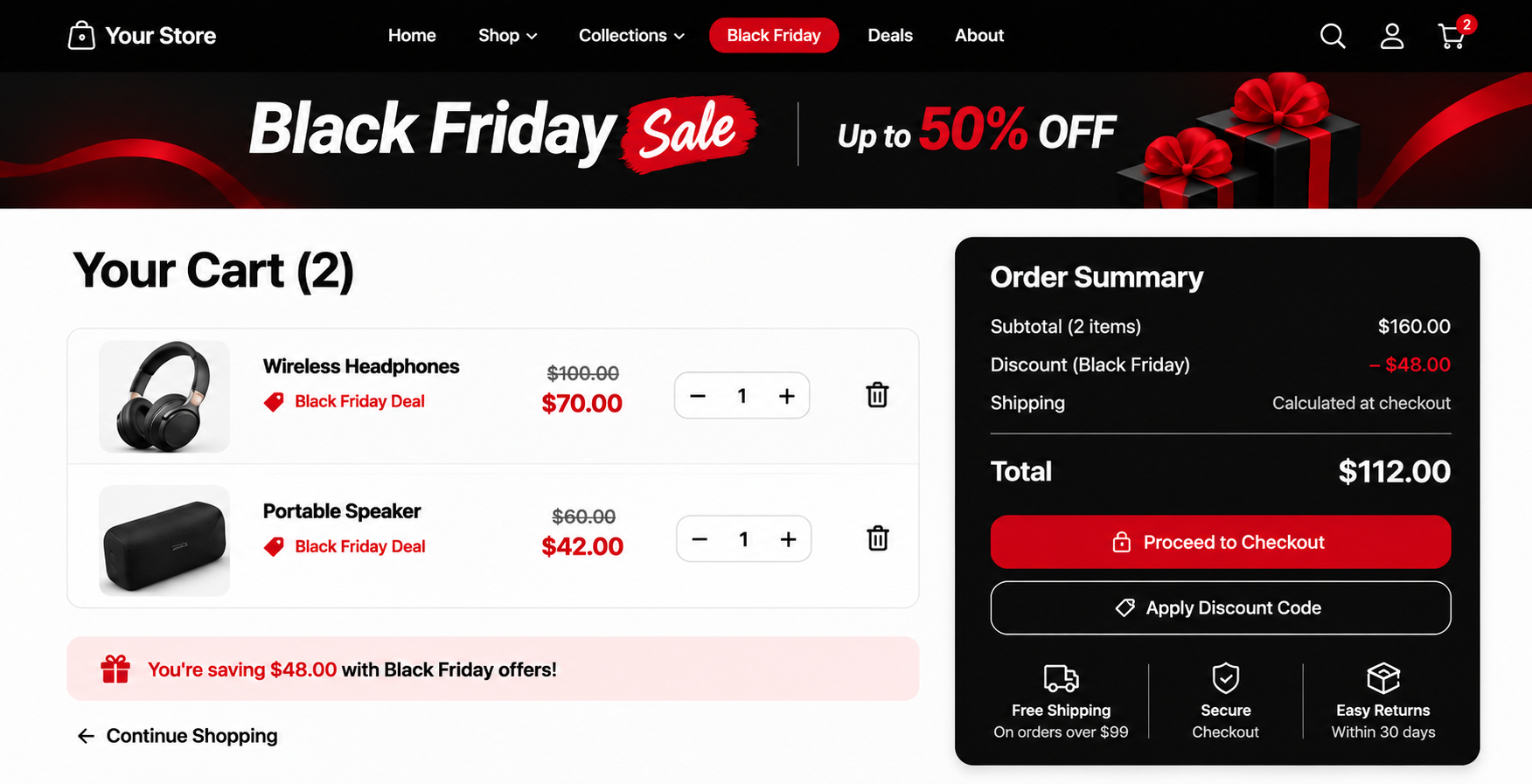
- A progress bar toward free shipping or a gift.
- Accelerated checkout buttons (Shop Pay, Apple Pay, Google Pay).
- Clear display of discounts applied and estimated delivery.
- Minimal distractions and fast loading.
- Express shipping options with transparent cut-offs.
Search and navigation
Many deal hunters use search. Add synonyms (for example sneakers and trainers), merchandise search results by best sellers, and surface the Black Friday collection in predictive search. Shopify Search & Discovery lets you manage synonyms, product boosts and filters without code.
Reduce abandonment
- Exit-intent or timed pop-ups that offer help, not just a discount.
- Back-in-stock and low-stock alerts.
- Live chat or AI assistant for sizing, shipping and offer questions, with escalation to a human.
- Cart abandonment emails and SMS within one hour, then again within 24 hours.
Test, but wisely
During peak weeks, run only high-confidence tests, because traffic mix and intent shift sharply. Prioritise tests with clear hypotheses, for example offer placement or free-shipping messaging, and avoid changes that could break checkout.
How Can Shopify Plus Help During Black Friday Sales?
Shopify Plus is Shopify’s enterprise-level plan. It is not required to run a successful Black Friday campaign, but it offers capabilities that help high-volume or complex stores. Features and availability change, so verify current details with Shopify.
| Plus capability | How it helps on Black Friday |
| Launchpad | Schedule sales, theme publishes, discounts, price changes and inventory releases to occur at an exact time, then automatically revert, reducing midnight manual work and human error |
| Shopify Flow (advanced use) | Automate tagging, alerts, inventory protection, fraud review and order routing at scale |
| Checkout extensibility and Shopify Functions | Customise discounts, shipping options, payment method display and cart validation, for example tiered discounts, gift with purchase logic and purchase limits |
| Checkout branding and UI extensions | Add upsells, custom fields and messaging in checkout and the thank-you page |
| Higher API limits and bulk operations | Support large catalogue and inventory updates and integrations at peak volume |
| Expansion stores and Markets | Run separate storefronts or regions with distinct offers, currencies and languages |
| B2B on Shopify | Offer volume pricing, company-specific catalogs and quick order flows for wholesale customers |
| Dedicated support and partner resources | Faster escalation channels and merchant success resources during peak events |
| Bot and abuse protection tools | Help manage scalpers and automated purchasing on limited drops, as available |
How to use Plus well
- Use Launchpad to schedule your Black Friday start and end, including theme changes and automatic discounts, and QA the schedule on a staging or preview theme.
- Build Shopify Functions for complex discount logic that stock settings cannot handle, such as tiered offers combined with member pricing, and test combinations thoroughly.
- Use checkout extensions for post-purchase offers and gift selection.
- Create Flow workflows that tag high-risk orders, hold fulfilment for review and alert you about stock and abnormal order patterns.
- Coordinate with your Shopify Plus partner company or merchant success manager about expected traffic, flash-sale plans and escalation paths.
- Remember: older customisation methods such as Shopify Scripts and checkout.liquid are being replaced by Functions and checkout extensibility, so make sure any legacy logic has been migrated well before the event.
Do you need Plus for Black Friday?
If your store has simple discounts, moderate volume and a single market, standard Shopify plans can do very well using automatic discounts, discount codes, Flow where available and well-built landing pages. Consider Plus if you need advanced checkout logic, scheduled changes without manual intervention, multiple storefronts, B2B, or very high peak volumes with complex integrations. Upgrading in the last two weeks before Black Friday adds risk, so only do it if the benefits clearly justify the change, and not without time to test.
Operations: Inventory, Shipping, Support and Fraud
A beautiful campaign fails if you cannot deliver. Operations protect revenue, reviews and repeat purchases.
Inventory
- Forecast demand per SKU using last year’s data, current list size and planned ad budgets, and add a buffer for hero items.
- Confirm supplier stock and lead times, and arrange backup suppliers for best sellers.
- Use pre-order or waitlist settings for items that may sell out, and be clear about shipping dates.
- Track sell-through hourly during launch and adjust ad spend and messaging.
Shipping and delivery promises
- Publish order-by dates for holiday delivery by shipping method, and show them on product pages, the cart and emails.
- Confirm carrier cut-offs and surcharges, and check carriers’ peak-season capacity warnings.
- Offer expedited options and consider a modest threshold for free standard shipping.
- Prepare warehouse capacity: staffing, packaging, label printing and daily cut-off times. If you use a 3PL, confirm their peak processing times in writing.
- For dropshipping, ask suppliers about peak processing delays and update delivery estimates accordingly. Overpromising is the leading cause of Black Friday refunds and chargebacks.
Customer support
- Staff up, or extend hours, for the event week.
- Prepare macros and an FAQ page covering shipping times, order edits, returns, discount rules and gift receipts.
- Use an AI assistant for common questions such as order status and policy details, backed by approved content, with clear escalation to a human.
- Monitor social comments and reviews, and reply quickly.
- Send proactive shipping-delay notices before customers contact you.
Returns policy for the holidays
Consider a holiday returns window that runs into January. It reduces purchase anxiety and often lifts conversion, though it should be modelled against your return rate.
Fraud and risk
Black Friday attracts fraudsters. Use Shopify’s built-in fraud analysis, and consider Shopify Protect where available. Create Flow workflows that tag orders with mismatched addresses, unusually large quantities or high risk scores, and hold them for manual review. Watch for abnormal discount code usage, which can indicate leaked codes. Set purchase limits on doorbusters to deter resellers. Keep chargeback evidence organised: delivery proof, communication logs and policy acceptance.
Analytics, Attribution and Black Friday KPIs
Metrics to watch live
| Metric | Why it matters |
| Sessions and traffic source mix | Identify channels driving the surge |
| Conversion rate by device | Spot mobile friction quickly |
| Average order value | Track the effect of bundles and tiers |
| Revenue and orders per hour | Pace against targets |
| Discount rate and discount code usage | Spot leakage and margin erosion |
| Contribution margin per order | Real profitability |
| MER (revenue divided by total ad spend) | Blended efficiency across channels |
| New versus returning customers | Acquisition versus loyalty impact |
| Cart and checkout abandonment | Funnel health |
| Stock on hero SKUs | Avoid selling out unexpectedly |
| Page speed and error rates | Early warning of technical trouble |
| Support ticket volume and response time | Operational stress |
Attribution realism
Platform-reported conversions often overlap and over-count, especially during Black Friday when shoppers touch many channels. Compare platform data with Shopify’s own sales numbers and GA4. Use discount code and UTM tracking to separate channel performance, and use post-purchase surveys asking how you hear about us to catch untracked influence from podcasts, creators and word of mouth. Evaluate performance on a blended basis, then use platform data for tactical optimisation.
Post-event analysis
After the event, build a report covering revenue, orders, new customers, AOV, margin, discount cost, channel performance, creative winners, stock outcomes, support volume, refund and chargeback rates and speed metrics. Add a section of what we would do differently. Store it with your calendar, creative and flows so next year’s planning begins with real data.
Compliance: Pricing, Privacy and Messaging Rules
AI and automation do not remove legal responsibility. Review these areas with qualified advice for your markets.
- Reference pricing: if you show a was price or compare-at price, it should reflect a genuine recent selling price. Rules differ by region. For example, the EU’s consumer pricing rules generally require disclosing the lowest price in the prior 30 days for announced reductions, and UK and US regulators have rules about misleading price claims. Check current requirements in each market you sell in.
- Urgency and scarcity claims: countdown timers and low-stock messages must be truthful. Fake urgency is increasingly restricted.
- Discount terms: state exclusions, end dates, quantity limits and whether offers can be combined.
- Email and SMS consent: obey CAN-SPAM, GDPR, ePrivacy, TCPA, CASL and local laws, and honour opt-outs promptly.
- Data privacy and cookies: keep consent banners accurate and ensure tracking respects user choices.
- Advertising claims: substantiate claims about performance, savings and sustainability, and follow platform ad policies.
- Influencer disclosure: require creators to disclose partnerships clearly.
- Accessibility: timers, banners and pop-ups should be accessible to keyboard and screen reader users.
- Refunds and returns: apply consumer protection requirements for your markets, including statutory rights.
Cyber Monday, the Final Week and Post-Sale Retention
Cyber Monday
Give Cyber Monday its own angle rather than repeating Black Friday: a new product drop, a category flash sale, a bundle upgrade or a final-hours reminder. Update your landing page and banner by Sunday evening, schedule emails and SMS, and refresh ad creative. Check stock again, since many items will have sold during the weekend.
Giving Tuesday and the shipping deadline push
The days after Cyber Monday are strong for gift shoppers who missed the first wave. Promote shipping cut-offs, gift cards (digital delivery avoids shipping deadlines) and charity tie-ins. Keep your gift guide and best-seller collections visible.
Post-purchase experience
Send order confirmation with clear delivery expectations, shipping updates, and an easy way to contact support. Use the thank-you page and post-purchase emails to introduce your brand story, set up product care tips and invite customers to join your loyalty program.
Turn Black Friday buyers into repeat customers
Black Friday buyers are often deal-driven, so retention takes deliberate effort:
- Welcome and onboarding series introducing your brand and best sellers.
- Review requests timed after delivery, with photo incentives.
- Cross-sell flows with complementary products, at full or lightly discounted price.
- Replenishment reminders for consumables.
- Loyalty enrolment with a bonus for second purchase in January.
- Segmentation by discount sensitivity, so you do not train everyone to wait for sales.
- Win-back campaigns for customers who bought once and did not return.
January retention play
Plan a post-holiday campaign: gift card redemption reminders, New Year offers, replenishment and a loyalty bonus. Gift recipients are a valuable new audience, so include them in welcome flows if you can identify them.
Retrospective
Hold a retrospective within a week, while memories are fresh. Record what worked, what broke and what to start earlier next year. Update this plan as a living playbook.
Black Friday Work With Viha Digital Commerce
Viha Digital Commerce helps Shopify brands prepare for peak sales with practical, technical and marketing support. Depending on your timeline and needs, we can help with:
- Shopify store optimisation: speed audits, app clean-up, theme performance work and mobile UX fixes.
- Black Friday landing pages and promotional sections: editable, metafield-driven modules so your team can launch and update offers without developers.
- Shopify theme customisation: announcement bars, badges, tiered-reward progress bars, bundle sections and cart enhancements.
- Discount and checkout logic: automatic discount setup, Shopify Functions and checkout extensions on Plus.
- Integration and inventory checks: ERP, 3PL, shipping and marketing tool synchronisation.
- Tracking and analytics setup: GA4, Conversions API and dashboards.
- SEO and AI search visibility: landing page SEO, structured data and product data improvements.
- Ongoing support and maintenance through the event weekend and after.
With four weeks to go, the most valuable steps are a performance and app audit, a clear offer and landing page, a tested tracking setup and a code freeze plan. Talk to Viha Digital Commerce about your Black Friday needs, and we will help you prioritise what fits your timeline.
Frequently Asked Questions
What are the best Black Friday marketing ideas for 2026?
The strongest ideas are early-access sales for subscribers, a dedicated Black Friday landing page, bundles and gifts with purchase, tiered spend rewards, segmented email and SMS campaigns, tightly managed paid media with a clean product feed, a fast and stable store, honest urgency, and reliable fulfilment with clear shipping cut-offs.
How to increase Shopify sales on Black Friday?
Raise traffic through email, SMS, ads and creators, then convert it by speeding up the store, simplifying checkout, showing offers on product pages and in the cart, and using bundles and tiered rewards to lift average order value. Track contribution margin so higher sales also mean higher profit.
How to prepare a Shopify store for Black Friday 2026?
Lock your offers and margins, audit and remove unnecessary apps, test speed and checkout on mobile, verify tracking, sync inventory, build your landing page, prepare email and SMS flows, schedule support coverage, create a runbook and set a code freeze date such as November 23.
How to create a Black Friday landing page on Shopify?
Create a new page template in the theme editor, add sections for a hero offer, featured deals, bundles, tiered rewards, social proof, FAQs and signup, assign it to a page at an evergreen URL such as /pages/black-friday, power the product grid with tagged smart collections, and use automatic discounts so shoppers do not need codes.
How to promote Black Friday deals for an online store?
Build a waitlist, run early access for VIPs, send segmented email and SMS campaigns, use Meta, Google and TikTok ads with retargeting, partner with creators, publish gift guides, post consistent social content and keep your offer visible across the site.
How to customize a Shopify store for Black Friday promotions?
Add an announcement bar, a hero banner linking to the landing page, deal badges on product cards, offer reminders on product pages, a free-shipping or gift progress bar in the cart, and a Black Friday navigation link. Use theme settings and metafields so marketing can update content without code.
How to improve Shopify store performance before Black Friday?
Measure Core Web Vitals, remove unused apps, defer third-party scripts, optimise and properly size images, trim JavaScript, simplify Liquid loops, test integrations under load and freeze changes before the event.
How to attract more customers during Black Friday sales?
Grow your list before the event, use early access, run prospecting ads in early November, partner with creators, publish SEO and gift-guide content, and keep retargeting active so interested shoppers return.
What are the best Black Friday promotions for ecommerce stores?
Bundles, gifts with purchase, tiered spend discounts, free shipping thresholds, early access for subscribers, doorbusters with purchase limits, loyalty multipliers and limited editions. The best choice depends on margin, audience and goals.
How to increase ecommerce sales without offering huge discounts?
Raise average order value with bundles and tiers, add value through gifts, extended returns and free gift wrap, reduce checkout friction, offer payment flexibility and segment offers so only the shoppers who need a nudge receive a discount.
How to optimize a Shopify store for Black Friday sales?
Focus on speed, mobile usability, clear offers on every key page, accurate stock, tested checkout, strong product pages with reviews and delivery estimates, working tracking and fast support.
How can Shopify Plus help during Black Friday sales?
Plus adds Launchpad for scheduled launches, Shopify Functions and checkout extensibility for advanced discount and checkout logic, higher automation and API capacity, expansion stores and B2B features, and dedicated support channels. It is helpful for complex or high-volume stores, but standard plans can also run successful campaigns.
When should I launch my Black Friday sale?
Many brands launch early access in the days before Black Friday and open to everyone on Thanksgiving evening or Black Friday morning. Choose based on your audience, ad budget and operations, and keep the timeline simple enough to run well.
Is it too late to prepare if I start on October 29?
No. You have about four weeks. Prioritise a clear offer, a landing page, a performance and app audit, tracking checks, email and SMS flows, and a code freeze. Skip large redesigns and new integrations.
Conclusion
The best Black Friday marketing ideas for 2026 are the ones that fit your margins, your audience and your operations. Build an offer ladder that rewards your best customers first, use bundles, gifts and tiers to protect profit, make your store fast and reliable, put email and SMS at the centre of your plan, run focused paid media and keep your promises on shipping and support. Measure contribution margin rather than revenue alone, and use what you learn to start next year’s preparation early.
With Black Friday on November 27, you have time to do the essentials well. Start with the offer and the maths, build the landing page, tune performance, test everything, freeze changes and then run the event with calm, data-driven decisions.
Need help getting your Shopify store ready? Viha Digital Commerce can audit your store, build your landing page and promotional sections, tune performance and support you through the event. Get in touch today.







 All-in-One Solution
 Customizable Services
 Assortment of Payment Options
 Optimized Sales Processes
 Omnichannel Maintenance & Support
 Custom Shopping Cart
 Advanced Security & Support
 API Payment & Logistic Integrations
 Social Media Integration
 Professional Communication
 Skilled Developers
 Timing is Everything
 Secure Agreements
 Support Tilt
 Quality Top Up Most
 White Development Pathway
 Competitive Price Point