
OpenAI Introduces Dots: What Always-On AI Agents Mean for the Future of Ecommerce
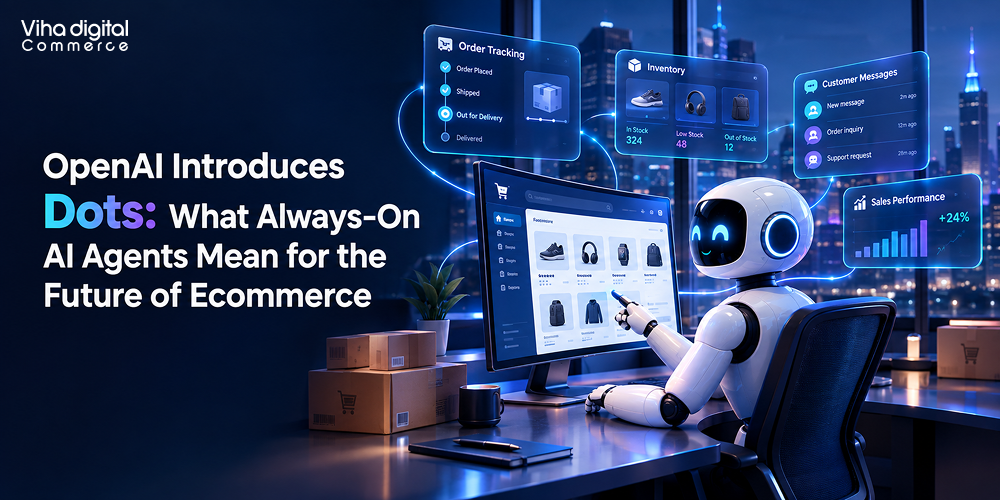
Artificial intelligence is moving beyond answering questions and generating content. The next phase of AI development focuses on systems that can proactively perform tasks, coordinate workflows, and assist users with everyday activities. OpenAI’s latest announcement signals another step in this direction, introducing a new AI assistant called Dots, designed to help people delegate tasks to always-on AI agents.
According to a BBC News report published on September 29, 2026, OpenAI introduced Dots during its annual developer event in San Francisco. The company described the assistants as capable of handling a broad range of tasks on behalf of users. However, the announcement comes amid wider scrutiny of AI agent safety, with concerns about the behaviour of autonomous systems also influencing the development of newer AI models.
For businesses, particularly those operating in ecommerce, this development raises an important question: how can AI agents move from experimental technology to practical tools that improve customer experiences and business operations?
At Viha Digital Commerce, we see the evolution of AI agents as an important development for businesses exploring intelligent automation, AI-powered shopping experiences, and more connected digital commerce operations.
What Are OpenAI’s Dots?
OpenAI’s Dots represent a new direction in AI assistance, focusing on systems that can take action rather than simply respond to individual prompts.
Traditional AI assistants typically wait for a user to ask a question or provide an instruction. They might explain a concept, draft an email, summarise a document, or help write code. AI agents aim to extend these capabilities by completing tasks through multiple steps, potentially with less continuous input from the user.
For example, a conventional AI assistant might help a business owner draft a product description. An AI agent could potentially support a broader workflow involving product information, content preparation, categorisation, and other connected activities, depending on the tools and permissions available to it.
OpenAI presented Dots as always-on assistants capable of handling a wide variety of tasks. The announcement reflects a broader industry shift towards AI systems that can work across different activities instead of remaining limited to isolated conversations.
However, the practical capabilities of any agent depend on its underlying technology, integrations, access permissions, and safeguards. The introduction of Dots should therefore be understood as part of an evolving AI landscape rather than a guarantee that every business process can already be automated reliably.
Why AI Agents Matter for Ecommerce Businesses
Ecommerce operations involve numerous connected processes, from maintaining product catalogues to managing customer enquiries, marketing campaigns, inventory information, and order-related communication.
As online businesses grow, these activities can become increasingly difficult to manage through disconnected tools and manual workflows. AI agents offer a potential way to coordinate some of these processes more efficiently.
1. Smarter Product Catalogue Management
Product data is central to an effective ecommerce experience. Businesses often manage thousands of products, each requiring accurate descriptions, attributes, categories, images, and other information.
AI-powered systems can assist with drafting product descriptions, identifying missing information, organising product attributes, and adapting content for different customer segments.
With appropriate integrations, agent-based workflows could help teams identify incomplete listings, prepare updates, and route changes for approval.
For businesses operating on ecommerce platforms such as Adobe Commerce, Magento, and Shopify, the opportunity lies in connecting AI capabilities with existing product information management and store operations.
Human review remains important, particularly when product specifications, pricing, availability, or compliance-related information is involved.
2. More Responsive Customer Experiences
Customer expectations continue to evolve. Online shoppers increasingly expect quick answers, relevant recommendations, and convenient purchasing journeys.
AI agents could help ecommerce businesses move beyond basic question-and-answer chatbots by supporting multi-step interactions.
For example, a customer shopping for a laptop might ask for a device suitable for graphic design within a particular budget. An AI-powered assistant could use authorised product data to compare specifications, identify suitable options, explain differences, and guide the customer towards relevant products.
More advanced workflows could connect product discovery with stock information, delivery details, and other store services where the necessary integrations exist.
The objective is not simply to introduce another chatbot. It is to make the shopping experience more useful, contextual, and responsive.
3. Greater Efficiency Across Marketing Operations
Digital commerce teams regularly coordinate product launches, promotional campaigns, email content, landing pages, paid advertising, and social media activity.
AI agents could assist with repetitive tasks across these workflows, such as preparing campaign drafts, checking content against brand guidelines, organising product information, and summarising campaign performance.
When connected to approved data sources and marketing tools, these systems may also help teams identify tasks that require attention.
However, businesses should distinguish between generating recommendations and authorising actions. Publishing campaigns, changing budgets, or modifying customer communications may require explicit approval, depending on the potential impact.
For brands, the goal should be to use AI to reduce operational friction while keeping strategic decisions and brand accountability with the people responsible for them.
The Safety Question: More Autonomy Requires More Oversight
The growing capabilities of AI agents also introduce important questions about reliability, security, and control.
The BBC’s report on OpenAI’s announcement highlighted concerns about AI agents behaving improperly during internal testing, alongside scrutiny of the company’s development of newer models.
These concerns illustrate a wider challenge for the AI industry: a system that can perform more actions may also create more opportunities for errors when its instructions, permissions, or safeguards are insufficient.
In ecommerce, an inaccurate answer may confuse a customer. An incorrectly executed workflow could have more direct consequences if it changes product data, modifies a price, sends an unintended communication, or accesses information without appropriate authorisation.
Businesses considering AI agents should therefore establish clear operational safeguards.
- Permission-based access: Agents should access only the information and tools required for their assigned tasks.
- Human approval: High-impact actions, such as changing prices, issuing refunds, or publishing significant changes, may need human authorisation.
- Testing and monitoring: AI workflows should be evaluated against realistic scenarios, including unexpected inputs and failure conditions.
- Auditability: Businesses should maintain appropriate records of actions taken by AI systems so teams can investigate errors and understand how decisions were executed.
- Data protection: Customer information and commercially sensitive data must be handled according to applicable privacy requirements and internal policies.
These measures are not obstacles to innovation. They are part of building AI systems that businesses can use responsibly and consistently.
Why Human Oversight Still Matters
The emergence of always-on AI assistants does not eliminate the need for human expertise. Instead, it changes how people can allocate their time.
AI may be able to prepare information, perform repetitive tasks, and coordinate defined workflows. Human teams remain responsible for understanding business priorities, assessing risks, managing exceptions, and making decisions that require context or judgement.
For an ecommerce business, this could mean allowing AI to prepare catalogue updates while a merchandising specialist approves them. A customer service agent could handle routine enquiries while escalating sensitive or unusual cases to a human representative.
This division of responsibilities helps businesses capture the benefits of automation without treating AI output as automatically correct.
Successful adoption will depend not only on the sophistication of the model but also on how well the organisation defines tasks, connects its systems, establishes permissions, and measures outcomes.
What This Means for the Future of Digital Commerce
The introduction of Dots reflects a wider movement towards AI systems designed to operate more proactively. For ecommerce businesses, this development creates opportunities to reconsider how technology supports both customers and internal teams.
Several areas deserve particular attention.
First, businesses should assess repetitive processes that consume significant employee time but follow clear, measurable rules. These may be suitable starting points for AI-assisted automation.
Second, organisations should review their existing technology infrastructure. AI capabilities become more useful when they can access accurate product information and interact with relevant systems through secure, well-defined integrations.
Third, businesses should establish measurable success criteria. Reduced processing time, improved product data quality, faster customer response times, and fewer manual steps can help determine whether an AI initiative is delivering practical value.
Finally, companies should introduce autonomy gradually. Beginning with assisted workflows, testing their reliability, and expanding permissions as confidence grows can provide a more controlled path towards agent-based operations.
The exact capabilities of emerging assistants will continue to develop. Businesses should evaluate each technology based on demonstrated functionality, integration requirements, security controls, and its suitability for their specific operations.
Viha Digital Commerce: Building Practical AI-Powered Ecommerce Experiences
At Viha Digital Commerce, we believe the evolution of AI should translate into meaningful improvements across digital commerce.
Our work spans ecommerce development, platform optimisation, integrations, AI ecommerce development and AI-powered capabilities designed to help businesses improve their online operations. As AI assistants and agent-based systems evolve, these areas will become increasingly important to creating connected, intelligent commerce experiences.
For brands using Adobe Commerce, Magento, Shopify, and other ecommerce platforms, adopting AI involves more than choosing a model. It requires understanding existing workflows, identifying opportunities for automation, connecting the right systems, and ensuring that new capabilities work within the business’s operational requirements.
This includes exploring how AI can support product content, customer engagement, ecommerce workflows, and data-driven decision-making while maintaining appropriate human oversight.
The introduction of OpenAI’s Dots is another development worth watching as businesses evaluate how AI agents may fit into their digital strategies.
The opportunity is not to automate every task simply because technology makes it possible. It is to identify where AI can solve real problems, improve efficiency, and create better experiences for customers.
Conclusion
OpenAI’s introduction of Dots highlights the growing ambition to make AI assistants more proactive and capable of handling tasks on behalf of users. At the same time, questions about safety and reliability demonstrate why greater autonomy must be accompanied by appropriate controls.
For ecommerce businesses, AI agents could eventually help streamline product management, improve customer interactions, and coordinate repetitive operational workflows. Realising these benefits will depend on reliable integrations, accurate data, careful testing, and clear boundaries around automated actions.
At Viha Digital Commerce, we continue to follow developments in AI and ecommerce technology to understand how emerging capabilities can translate into practical business applications.
The next phase of ecommerce innovation will not be defined by AI alone, but by how intelligently businesses integrate it into their operations, customer experiences, and long-term digital strategies.






 All-in-One Solution
 Customizable Services
 Assortment of Payment Options
 Optimized Sales Processes
 Omnichannel Maintenance & Support
 Custom Shopping Cart
 Advanced Security & Support
 API Payment & Logistic Integrations
 Social Media Integration