
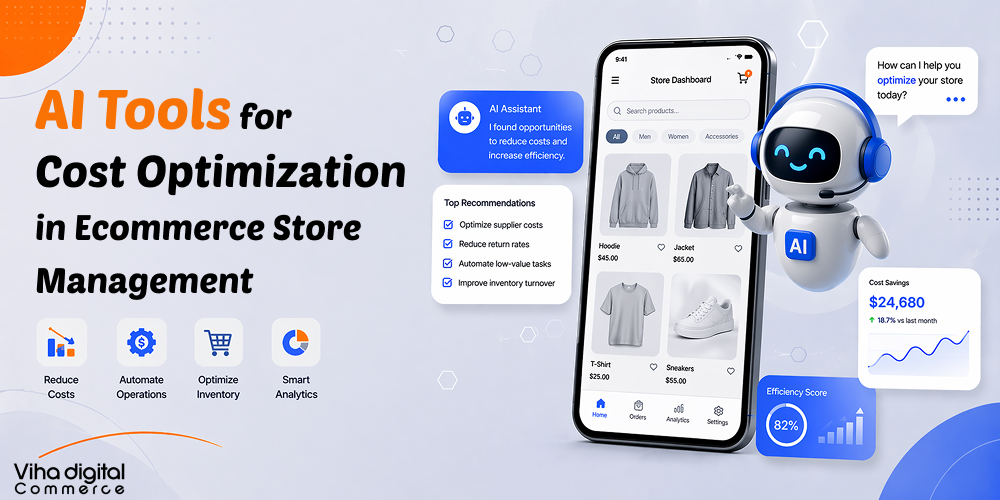
AI Tools for Cost Optimization in Ecommerce Store Management
Running an ecommerce store in 2025 is not cheap. Between rising customer acquisition costs, warehouse expenses, support overheads, and paid media spend, margins are under constant pressure. But here’s the shift that’s happening right now: smart online store owners are turning to AI in ecommerce — not just to sell more, but to spend less.
AI for ecommerce is no longer a buzzword reserved for enterprise giants. With the explosion of accessible ecommerce AI tools, even mid-size and growing online businesses can now automate repetitive tasks, make smarter inventory decisions, personalize customer journeys, and significantly reduce operational costs — all without expanding headcount.
In this blog, we break down the best AI tools for ecommerce businesses, the specific areas where AI delivers the biggest cost savings, and practical ecommerce cost optimization strategies using AI that you can start implementing today.
Why AI Is the Future of Ecommerce Cost Optimization
Before diving into specific tools, it’s worth understanding why AI is uniquely suited to solving cost problems in ecommerce.
Traditional ecommerce operations rely heavily on human decision-making for tasks like managing stock levels, writing product descriptions, responding to customer queries, and running ad campaigns. Each of these tasks is time-consuming, error-prone, and expensive at scale.
To overcome these limitations, many businesses are investing in modern ecommerce development that supports AI integrations, automation workflows, and real-time data processing across their entire store ecosystem.
AI changes that equation. By analysing historical data, customer behaviour, and real-time signals, AI tools for ecommerce can:
- Make faster and more accurate decisions than manual processes
- Predict demand before it becomes a problem
- Personalise at scale without adding staff
- Automate entire workflows end-to-end
- Reduce waste across inventory, marketing, and logistics
According to McKinsey research, AI adopters in supply chain and logistics have improved logistics costs by 15% and reduced inventory levels by 35%. These are not marginal improvements — they are business-transforming results.
Key Areas Where AI Tools Reduce Ecommerce Costs
Let’s look at the six core areas where AI delivers measurable cost savings for online stores.
1. Inventory Management and Demand Forecasting
Overstocking and stockouts are two of the highest hidden costs in ecommerce. Too much inventory ties up capital and increases warehousing costs. Too little means lost sales and frustrated customers.
Smart AI tools for online store management use machine learning to analyse historical sales data, seasonal trends, and even external signals, such as social media demand spikes, to predict exactly how much stock you need and when.
Key benefits:
- Automated restocking triggers that prevent stockouts
- Reduced dead stock and storage costs
- Better capital allocation across your product catalogue
- Real-time inventory visibility across multiple channels
2. AI-Powered Customer Support and Best Ecommerce Chatbots
Customer support is one of the highest operational costs for ecommerce businesses. Hiring, training, and retaining support agents is expensive — and round-the-clock coverage is nearly impossible without significant investment.
The best AI-powered ecommerce chatbots can handle a wide range of customer interactions autonomously — from order tracking and return requests to product recommendations and cart abandonment recovery — without human involvement.
Modern AI chatbots for ecommerce go far beyond scripted FAQ bots. They use natural language processing to understand customer intent, personalise responses, and escalate only the truly complex issues to your human team. This means your support staff can focus on high-value interactions while AI handles the volume.
Cost impact:
- Reduces support ticket volume by 40–70% on average
- Available 24/7 with zero additional staffing cost
- Faster resolution times improve customer satisfaction and reduce churn
- Upselling and cross-selling are built directly into support conversations
3. Dynamic Pricing and Revenue Optimisation
Static pricing is a missed opportunity. AI pricing tools continuously monitor competitor prices, demand signals, and your own sales velocity to recommend or automatically apply the optimal price for every product — at every moment.
This isn’t just about increasing prices when demand is high (though it does that). It’s about intelligently discounting slow-moving stock before it becomes dead inventory, running flash sales at the optimal time, and protecting margins across your entire catalogue.
For ecommerce cost optimization:
- Reduce manual pricing labour
- Minimise revenue leakage from underpricing
- Clear ageing stock efficiently to free up warehouse space
- Stay competitive without constantly monitoring rivals manually
4. AI-Driven Marketing Automation and Reducing Customer Acquisition Costs
Customer acquisition cost (CAC) is the single biggest drain on profitability for most ecommerce businesses. Running ad campaigns, producing content, managing email flows, and retargeting lost visitors all cost money — and most of it is wasted on the wrong audience at the wrong time.
AI tools for ecommerce cost optimization in marketing work by analysing customer behaviour data to identify who is most likely to buy, when they are ready to be contacted, and what message will resonate with them. This precision dramatically reduces ad spend waste.
What AI marketing tools do:
- Automated audience segmentation based on real-time behaviour
- Predictive send-time optimisation for email and SMS
- Dynamic ad creative personalisation
- Cart abandonment recovery with personalised nudges
- Lookalike audience generation to lower CPAs
According to McKinsey, AI-driven personalisation delivers 10–30% more marketing efficiency and a 3–5% increase in customer acquisition, while reducing cost per acquisition significantly.
5. Supply Chain and Logistics Optimisation
Shipping and fulfilment costs continue to be a major expense for online stores. AI in ecommerce supply chain management helps reduce these costs by optimising shipping routes, predicting delivery delays, and improving warehouse operations.
AI helps you:
- Select the cheapest and fastest carrier for each shipment automatically
- Predict supply chain disruptions before they affect customers
- Optimise warehouse pick-and-pack routes to reduce labour time
- Consolidate orders to reduce shipping costs per unit
6. AI-Powered Content and Product Description Automation
Writing product descriptions, meta titles, blog content, and ad copy is time-consuming and expensive when outsourced to copywriters. AI content tools can generate high-quality, SEO-optimised product content at scale — in a fraction of the time and cost.
For ecommerce businesses with large catalogues (think 500+ SKUs), this is a game-changer. Instead of spending weeks writing descriptions, AI can produce consistent, brand-aligned content for your entire product range within hours.
Additional AI content capabilities:
- Automated image alt-text generation for accessibility and SEO
- AI-driven keyword research and on-page SEO suggestions
- Personalised email subject lines and copy variations
- Multilingual product content at no extra translation cost
Best AI Tools for Ecommerce Businesses: A Quick Reference
Here’s a consolidated list of the best AI tools for ecommerce cost optimization, organised by function:
Inventory & Demand Forecasting: Inventory Planner, Linnworks, Brightpearl AI
Customer Support & Best Ecommerce Chatbots: Tidio AI, Gorgias, Intercom Fin, Zendesk AI
Dynamic Pricing: Prisync, Wiser, Omnia Retail, Competera
Marketing Automation & Personalisation: Klaviyo AI, Omnisend, Meta Advantage+, Google PMax
Supply Chain & Logistics: ShipBob, Flexport, EasyPost, Shipstation AI
Content & SEO Automation: Hypotenuse AI, Jasper, Copy.ai, Surfer SEO
Fraud Detection: Signifyd, Kount, Forter
Website Personalisation: Dynamic Yield, Nosto, Barilliance
How AI Can Automate Ecommerce Store Management End-to-End
One of the most exciting developments in AI for ecommerce is the shift from point solutions to full store automation. Rather than using separate tools for each function, forward-thinking merchants are building AI-powered operations stacks that work together.
Here’s what a fully AI-automated ecommerce workflow looks like:
- A customer visits your store → AI personalises the homepage in real time based on their browsing history
- They search for a product → AI-powered search surfaces the most relevant results with smart ranking
- They hesitate on a product page → AI chatbot proactively answers their question and offers a targeted discount
- They abandon the cart → AI sends a personalised email within the hour with the exact product they left
- They purchase → AI updates inventory levels and triggers a restocking order if needed
- They receive the order → AI selects the optimal carrier based on cost and delivery time
- Post-delivery → AI sends a review request and personalised product recommendation for their next purchase
This is the reality of how AI can automate ecommerce store management today — and it’s available to businesses of all sizes, not just enterprise players.
Benefits of AI for Ecommerce: Beyond Just Cutting Costs
While cost optimization is the central focus of this blog, it’s important to recognise that the benefits of AI for ecommerce extend well beyond the bottom line. When you reduce costs through AI, you simultaneously improve customer experience — and that creates a compounding advantage.
- Higher customer lifetime value: Personalised recommendations and proactive support keep customers coming back, reducing the need for expensive re-acquisition.
- Fewer returns: AI-powered size guides, detailed product descriptions, and better product matching reduce return rates, saving both logistics costs and customer service effort.
- Faster time to insight: AI dashboards surface actionable data instantly, allowing you to make smarter decisions faster — without expensive data analysts.
- Scalability without proportional cost increases: As your store grows, AI tools scale with you. You don’t need to double your headcount to double your revenue.
- Improved fraud prevention: AI fraud detection tools reduce chargebacks and fraudulent orders, protecting margins without manual review overhead.
Ecommerce Cost Optimization Strategies Using AI: Where to Start
If you’re new to using AI tools for ecommerce, the range of options can feel overwhelming. Here’s a practical prioritisation framework based on where you’ll see the fastest ROI:
Step 1 — Start with customer support automation. Deploying an AI chatbot is typically the fastest win. Setup is relatively low-effort, and the cost savings from reduced ticket volume are immediate and easy to measure.
Step 2 — Fix inventory forecasting. Overstocking and stockouts are silent profit killers. AI inventory tools often pay for themselves within the first quarter by reducing dead stock and preventing lost sales.
Step 3 — Automate your email and SMS marketing. AI marketing tools like Klaviyo can dramatically improve open rates and conversion while reducing the manual labour of campaign management.
Step 4 — Implement dynamic pricing. Once your data infrastructure is solid, adding AI pricing tools creates a continuous, autonomous revenue optimisation layer that works around the clock.
Step 5 — Automate content at scale. As you grow, use AI content tools to handle product descriptions, SEO meta data, and blog content so your team can focus on strategy rather than execution.
How Viha Digital Commerce Can Help
Viha Digital Commerce specialise in implementing AI-powered ecommerce solutions on platforms including Shopify, Adobe Commerce (Magento), and headless commerce stacks. Whether you’re looking to deploy your first AI chatbot, build out a full marketing automation stack, or integrate intelligent inventory management into your existing systems — we’ve done it.
We work with ecommerce businesses to identify the highest-impact AI opportunities specific to their store, their customer base, and their operational bottlenecks — and then implement them in a way that delivers measurable results.
Ready to reduce costs and run a smarter store? Get in touch with the Viha Digital Commerce team today.
Final Thoughts
AI in ecommerce has moved well past the hype phase. The best AI tools for ecommerce cost optimization are proven, accessible, and deliver real results for stores of all sizes. From the best ecommerce chatbots that handle support at scale, to predictive inventory tools that eliminate waste, to smart marketing automation that slashes customer acquisition costs — AI is the most powerful lever available to ecommerce operators right now.
The stores that win the next five years will not necessarily be the ones with the biggest budgets. They’ll be the ones that use AI intelligently — to do more, waste less, and serve their customers better than anyone else.






 All-in-One Solution
 Customizable Services
 Assortment of Payment Options
 Optimized Sales Processes
 Omnichannel Maintenance & Support
 Custom Shopping Cart
 Advanced Security & Support
 API Payment & Logistic Integrations
 Social Media Integration