
Software as a Service (SaaS) in Ecommerce: Market Trends, Growth Drivers & Forecast 2026–2034
Ecommerce has moved decisively onto the cloud. Retailers that once wrestled with servers, patches, and custom code are now running storefronts on subscription-based, always-updated infrastructure, and the shift is reshaping how brands sell online. This report looks at where the SaaS ecommerce market stands today, what is driving its growth through 2034, and how businesses can choose the right platform strategy.
SaaS Ecommerce Market: Size, Growth & Forecast Overview
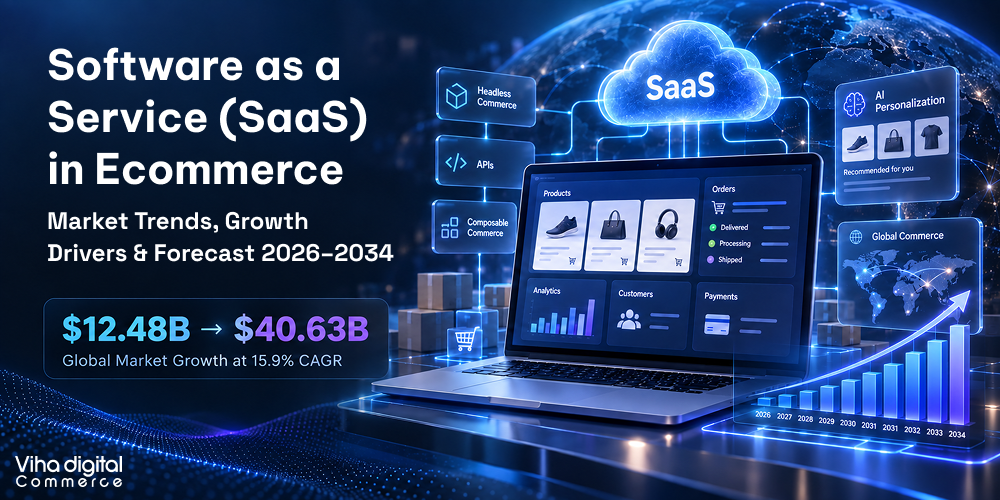
The global SaaS ecommerce market was valued at approximately $12.48 billion in 2026 and is projected to reach $40.63 billion by 2034, expanding at a CAGR of around 15.9% during the forecast period. This growth sits inside a much larger cloud-software boom; the broader SaaS ecommerce market is one of the fastest-growing verticals within the wider software-as-a-service industry, which itself is forecast to top $1.4 trillion globally by 2034.
Figure 1 illustrates the market’s growth trajectory across the forecast window.
| Year | Market Size | Relative Growth |
| 2026 | $12.48B | █████████ |
| 2027 | $14.46B | ██████████ |
| 2028 | $16.76B | ████████████ |
| 2029 | $19.42B | █████████████ |
| 2030 | $22.51B | ████████████████ |
| 2031 | $26.09B | ██████████████████ |
| 2032 | $30.24B | █████████████████████ |
| 2033 | $35.05B | ████████████████████████ |
| 2034 | $40.63B | ████████████████████████████ |
Key Takeaways
- 2026 market size: ~$12.5 billion; 2034 forecast: ~$40.6 billion
- Forecast CAGR: ~15.9% between 2026 and 2034
- North America leads on adoption; Asia Pacific and MEA post the fastest regional CAGRs
- B2B SaaS ecommerce is the fastest-growing application segment, with SaaS platforms still serving only 12–15% of potential B2B digital-commerce workloads , the biggest headroom in the market
- Cloud-based SaaS storefronts already process an estimated $2+ trillion in annual gross merchandise volume worldwide
What Is Driving SaaS Ecommerce Adoption?
Market Trend: The Rise of Headless and Composable Commerce
Headless SaaS commerce architecture , where the storefront front-end is decoupled from the backend commerce engine , is quickly becoming the default choice for growing brands. It lets merchants plug in best-of-breed tools for search, personalization, and checkout without rebuilding the whole platform, and vendors like VTEX, Adobe, and Salesforce are investing heavily in API-first, composable offerings to meet this demand.
Market Driver: Multi-Cloud and Enterprise-Grade Reliability
Enterprises are increasingly building a multi-cloud SaaS ecommerce strategy , spreading catalog, payments, and analytics workloads across providers such as AWS, Azure, and Google Cloud to avoid vendor lock-in and improve uptime. This is pushing SaaS commerce vendors to certify their platforms across multiple hyperscalers, a major factor behind enterprise SaaS ecommerce adoption.
Market Restraint: Security and Scalability Challenges
Multi-tenant SaaS environments concentrate sensitive customer and payment data, and misconfiguration remains a leading cause of breaches across the wider SaaS industry. Buyers evaluating ecommerce SaaS platforms should weigh SaaS ecommerce security and scalability challenges carefully, checking for SOC 2 / PCI-DSS compliance, granular access controls, and proven peak-traffic performance before committing.
Market Opportunity: AI-Powered Personalization
AI-powered SaaS ecommerce solutions are moving from novelty to necessity. Vendors are embedding generative AI into merchandising, dynamic pricing, visual search, and customer support, letting even small teams deliver the kind of personalization once reserved for enterprise retailers, a major reason more brands are switching to SaaS ecommerce rather than maintaining custom stacks.
SaaS Ecommerce Platform vs Custom Development
One of the most common decisions brands face is SaaS ecommerce platform vs custom development. The table below summarizes how a SaaS commerce solution compares with an on-premise or fully bespoke build, the classic SaaS vs on-premise ecommerce trade-off.
| Factor | SaaS Ecommerce | On-Premise / Custom Build |
| Upfront cost | Low (subscription-based) | High (licences, servers, infra) |
| Time to launch | Weeks | Months to years |
| Maintenance | Handled by vendor | In-house IT team required |
| Scalability | Elastic, on-demand | Manual capacity planning |
| Updates & security patches | Automatic, continuous | Scheduled, resource-intensive |
| Customization depth | Moderate to high (headless options) | Very high, fully bespoke |
| Best fit | Fast-scaling brands, most B2B/B2C teams | Highly regulated or unique legacy workflows |
For most retailers, the benefits of SaaS ecommerce platforms for businesses , lower upfront cost, faster go-live, automatic updates, and elastic scalability , outweigh the deeper (but slower and costlier) customization that a fully custom build allows. Custom development still makes sense for highly regulated industries or brands with truly unique operational workflows that no cloud-based ecommerce platform can accommodate out of the box.
Best SaaS Ecommerce Platforms 2026
Cloud-based ecommerce platforms vary widely in target audience, flexibility, and depth of B2B functionality. Here is how the leading names compare:
| Platform | Model | Best For | Standout Strength |
| Shopify | Pure SaaS | SMB to mid-market | Fast launch, huge app ecosystem, strong B2C UX |
| BigCommerce | SaaS / open-SaaS | Mid-market to enterprise | Open APIs, strong B2B feature set out of the box |
| Salesforce Commerce Cloud | Enterprise SaaS | Large enterprise | Deep CRM/marketing integration, AI-driven personalization |
| Adobe Commerce Cloud (Magento SaaS) | Managed SaaS | Enterprise / complex catalogs | Flexible customization on a managed cloud backbone |
| VTEX / Elastic Path | Headless SaaS | Enterprise, multi-brand | Composable, API-first architecture for omnichannel |
Shopify remains the benchmark for fast, design-forward B2C launches. BigCommerce and Salesforce Commerce Cloud SaaS deployments lean into B2B feature depth and CRM integration, while the Adobe Commerce Cloud SaaS model appeals to enterprises needing deep customization on a managed backbone. For businesses selling to other businesses, a purpose-built SaaS ecommerce platform for B2B , with tiered pricing, quote workflows, and punch-out catalogs , is increasingly the default rather than the exception.
Regional Outlook
| Region | Approx. Share (2026) | Growth Notes |
| North America | 38.4% | Largest share; deep enterprise cloud adoption, mature B2B & B2C digital retail base |
| Asia Pacific | 27.1% | Fastest-growing region; smartphone-first retail, government digital-commerce pushes |
| Europe | 22.6% | Strong compliance-driven adoption (GDPR-ready SaaS), omnichannel B2B growth |
| Middle East & Africa | 6.8% | Highest regional CAGR through 2034 on new-economy retail investment |
| Latin America | 5.1% | Rising SME digitisation and cross-border marketplace expansion |
Why Businesses Are Switching to SaaS Ecommerce
- Lower total cost of ownership , no servers, data centers, or large upfront licence fees
- Faster time-to-market for new storefronts, markets, and sales channels
- Built-in scalability to absorb seasonal and viral traffic spikes without manual provisioning
- Continuous feature releases and security patching handled by the vendor
- Native integrations with payments, marketing, ERP, and AI tools, reducing custom engineering load
This combination is why SaaS ecommerce adoption keeps climbing across both B2C and B2B, and why so many growth-stage brands now default to a SaaS-first strategy rather than evaluating custom builds first.
The Road Ahead: Future of SaaS in Online Retail
Looking at SaaS ecommerce trends 2026 and beyond, expect three forces to shape the next decade: deeper generative-AI embedding across merchandising and support, continued growth of headless and composable architectures for enterprise SaaS ecommerce, and a widening runway in B2B, where SaaS penetration still lags far behind B2C. Vendors that combine strong SaaS commerce solutions with transparent security practices and flexible APIs are best placed to capture this growth.
For brands weighing a platform migration or a new build, the calculus increasingly favors partnering with an experienced saas development company that can architect, integrate, and scale a commerce stack, rather than treating saas development as a one-off project. Viha Digital Commerce works with growing and enterprise brands to plan, build, and optimize cloud-based ecommerce platforms suited to where the business is headed, not just where it is today.
Frequently Asked Questions
What is SaaS ecommerce?
SaaS ecommerce refers to online-store software delivered over the cloud on a subscription basis, where the provider hosts infrastructure, security, and updates so merchants only manage their storefront, catalog, and orders.
How big is the SaaS ecommerce market?
Industry estimates put the global SaaS ecommerce market at roughly $12.5 billion in 2026, growing to more than $40 billion by 2034 at a CAGR of around 15–16%.
What are the top SaaS ecommerce platforms?
Shopify, BigCommerce, Salesforce Commerce Cloud, Adobe Commerce Cloud, and headless players such as VTEX and Elastic Path are among the most widely deployed SaaS ecommerce platforms today.
Is Shopify a SaaS platform?
Yes. Shopify is a fully hosted, multi-tenant SaaS ecommerce platform , merchants pay a subscription fee, and Shopify manages hosting, security, and infrastructure.
Which ecommerce platform is best for scaling?
Enterprise-grade SaaS or headless SaaS platforms (Salesforce Commerce Cloud, Adobe Commerce Cloud, BigCommerce Enterprise, VTEX) generally scale best for high-growth or omnichannel B2B and B2C brands.
How much does a SaaS ecommerce platform cost?
Pricing ranges widely , from roughly $30–$300 per month for SMB-focused plans to custom enterprise contracts running into six figures annually, depending on GMV, features, and support levels.





 All-in-One Solution
 Customizable Services
 Assortment of Payment Options
 Optimized Sales Processes
 Omnichannel Maintenance & Support
 Custom Shopping Cart
 Advanced Security & Support
 API Payment & Logistic Integrations
 Social Media Integration