
How AI Personalization Boosts eCommerce Sales and Customer Experience
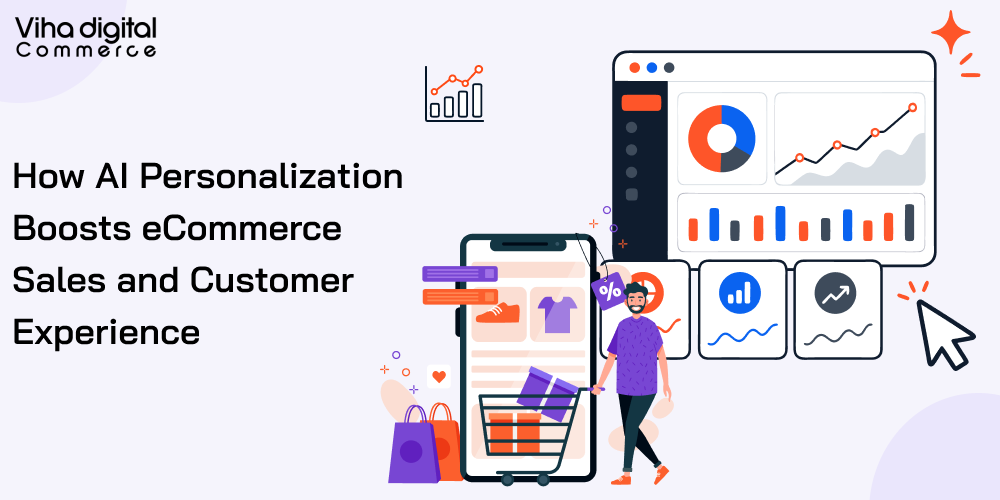
Imagine walking into a store where every product on display was chosen specifically for you where the salesperson already knows your style, your budget, and what you bought last time. That is exactly the experience AI personalization delivers online, at scale, in real time.
For eCommerce brands, this is no longer a futuristic concept. It is happening right now and it is directly driving revenue.
What Is AI Personalization in eCommerce?
AI personalization uses machine learning, behavioral data, and predictive analytics to tailor every aspect of the shopping experience to an individual user. Rather than showing every visitor the same homepage, the same product grid, or the same email campaign, AI dynamically adjusts what each shopper sees based on their unique signals browsing history, past purchases, location, device, time of day, and more.
Think of it as moving from a one-size-fits-all catalog to a curated storefront that rebuilds itself around every single visitor.
Why Generic Shopping Experiences Are Leaving Money on the Table
The average eCommerce conversion rate hovers between 1% and 4%. That means for every 100 visitors who land on a store, 96 or more leave without buying. A large part of this abandonment happens because the experience feels irrelevant shoppers are shown products they do not want, in categories they have never browsed, with messaging that does not speak to them.
Studies consistently show that personalized shopping experiences can lift conversion rates by 10–30%, increase average order values, and significantly improve customer retention. Shoppers who feel understood buy more, come back more often, and are far less likely to comparison-shop elsewhere.
6 Ways AI Personalization Increases eCommerce Sales
1. Personalized Product Recommendations
This is the most visible form of AI personalization and one of the highest-ROI applications in eCommerce. AI recommendation engines analyze purchase history, browsing behavior, and patterns from millions of similar shoppers to surface the exact products a customer is most likely to buy next.
Amazon famously attributes roughly 35% of its revenue to its recommendation engine. Shopify merchants using AI-powered recommendation apps report significant lifts in both average order value and revenue per session.
Recommendations appear across homepages, product detail pages, cart drawers, and post-purchase emails every touchpoint becomes an opportunity to surface the right product at the right moment.
2. Dynamic Search and Navigation
When a shopper types into a search bar, AI transforms that query into a personalized result set, not just keyword matches, but ranked results informed by that user’s behavior, preferences, and purchase history. A customer who consistently buys premium goods will see higher-end results first. A first-time visitor gets a more introductory mix.
AI-powered search also handles typos, synonyms, and natural language queries far better than traditional rule-based systems. Fewer “no results” pages means fewer lost sales.
3. Personalized Email and SMS Campaigns
Batch-and-blast email campaigns are dying. AI personalization allows brands to send the right message to the right person at the right time automatically. Subject lines, product selections, discount offers, and send times are dynamically adjusted for each recipient based on their behavior and lifecycle stage.
A customer who abandoned a cart gets a tailored reminder. A loyal buyer who has not purchased in 60 days gets a win-back offer featuring their most-browsed category. AI-driven email campaigns routinely outperform generic sends by 2–5x on open rates and click-through rates, translating directly into recovered revenue.
4. AI-Powered Upsells and Cross-Sells
Getting a customer to add one more item to their cart or upgrade to a higher-value product is one of the most cost-effective ways to increase revenue without acquiring new traffic. AI makes this smarter by analyzing what complementary products customers actually purchase together, rather than relying on manually curated bundles.
On Shopify, apps like Frequently Bought Together and LimeSpot use AI to generate dynamic upsell and cross-sell recommendations based on real purchase data. The result is a more natural, helpful suggestion that feels like a knowledgeable sales associate — not a generic “customers also viewed” widget.
5. Personalized Pricing and Promotions
AI can determine which customers are price-sensitive and which are not — and tailor promotional offers accordingly. Rather than offering a blanket 20% discount to every shopper, AI identifies which customers need a nudge to convert and serve them targeted offers, while preserving full-price purchases for customers who would have bought anyway.
This approach protects margin while improving conversion – a significant advantage over traditional sitewide sale events that train customers to wait for discounts.
6. On-Site Content and Homepage Personalization
First impressions matter enormously. AI personalization allows the homepage, hero banners, category navigation, and promotional messaging to adapt in real time based on who is visiting. A returning customer sees a welcome-back message and picks up where they left off. A first-time visitor from a specific ad campaign sees creative and products tailored to the ad they clicked.
This level of dynamic content delivery was once reserved for enterprise retailers with massive tech teams. Today, Shopify apps and eCommerce platforms have made it accessible to brands of all sizes.
Best AI Personalization Tools for Shopify and eCommerce
For brands looking to implement AI personalization without building proprietary technology, a strong ecosystem of tools is available:
- Nosto — Full-suite personalization platform covering recommendations, content, email, and search across the entire customer journey.
- Klaviyo — AI-powered email and SMS marketing with predictive analytics for send time, product recommendations, and churn prediction.
- LimeSpot — Shopify-native AI recommendations and upsell engine with real-time behavioral learning.
- Searchanise / Boost Commerce — AI-powered search and filtering solutions that personalize result rankings per user.
- Rebuy Engine — End-to-end personalization for Shopify including smart cart, post-purchase offers, and retention flows.
- Yotpo — AI-driven loyalty and reviews platform that personalizes retention marketing based on customer segments.
Each of these tools integrates directly with Shopify and most major eCommerce platforms, making deployment accessible without heavy engineering resources.
The Business Case: What the Numbers Say
The ROI on AI personalization is not theoretical. According to McKinsey, personalization can deliver 5–15% revenue uplifts and 10–30% increases in marketing spend efficiency for eCommerce companies that implement it well. Brands using advanced AI personalization report:
- Higher average order values — shoppers see more relevant upsells and add more to cart
- Lower cart abandonment rates — personalized recovery flows bring back hesitant buyers
- Improved customer lifetime value — relevant experiences drive repeat purchases
- Reduced customer acquisition costs — better retention means less reliance on paid acquisition
The compounding effect is significant. A 15% lift in conversion rate, combined with a 10% increase in average order value and improved retention, can double revenue over 12–18 months without any increase in ad spend.
Getting Started with AI Personalization
Brands do not need to implement every capability at once. The highest-impact starting points are:
- AI product recommendations — Install a recommendation engine on your product and cart pages. This is often the fastest path to measurable AOV lift.
- Personalized email flows — Upgrade abandoned cart, win-back, and post-purchase sequences with AI-driven product recommendations.
- AI-powered search — Replace basic keyword search with a behavioral search engine that learns from your customers.
From there, brands can layer in homepage personalization, predictive offers, and more sophisticated segmentation as they scale.
The Role of eCommerce Development in AI Personalization
Implementing AI personalization is not just about choosing the right tools, it also requires a solid eCommerce development foundation to support them. Whether you are building a new store from scratch or upgrading an existing one, AI eCommerce development involves integrating machine learning models, data pipelines, and personalization APIs into your storefront in a way that is fast, scalable, and conversion-optimized.
For off-the-shelf platforms like Shopify, much of this is handled through app integrations. But brands with more complex product catalogs, custom workflows, or unique customer journeys often benefit from custom AI eCommerce development – building tailored recommendation engines, dynamic pricing logic, or personalized search systems that plug seamlessly into their existing stack.
This is where the decision to hire an AI developer becomes critical. A skilled AI developer brings together expertise in machine learning, backend engineering, and eCommerce architecture translating AI capabilities into real business outcomes rather than just installing plugins.
When Should You Hire an AI Developer for eCommerce?
Not every brand needs a full-time AI engineer from day one. But hiring an AI developer makes strong sense when:
- Off-the-shelf tools are hitting their limits — Your product catalog is large and complex, and generic recommendation engines are surfacing irrelevant results.
- You need custom data integrations — Your customer data lives across multiple systems (CRM, ERP, POS) and needs a unified AI layer to make sense of it.
- Personalization is a strategic differentiator — You want proprietary AI models trained on your own data, not shared infrastructure that your competitors use too.
- You are scaling internationally — Personalization across multiple languages, currencies, and regional preferences requires custom development work.
Whether you choose to hire an AI developer in-house or partner with an AI eCommerce development agency, the key is finding someone who understands both the machine learning side and the commercial realities of eCommerce — conversion rates, cart behavior, and customer lifetime value.
Final Thought
AI personalization is not about technology for its own sake. It is about making every customer feel like your store was built for them — and when shoppers feel understood, they buy. The brands investing in AI-powered personalization and smart eCommerce development today are not just improving metrics; they are building a durable competitive advantage that becomes harder to replicate with every passing month.
For eCommerce brands at any stage, the question is no longer whether to personalize it or how fast to get started.
Ready to build a personalized AI eCommerce experience? Whether you need the right tools or are looking to hire an AI developer to build something custom, Viha Digital Commerce is here to help. The best time to start is now – book a call with our experts today.





 All-in-One Solution
 Customizable Services
 Assortment of Payment Options
 Optimized Sales Processes
 Omnichannel Maintenance & Support
 Custom Shopping Cart
 Advanced Security & Support
 API Payment & Logistic Integrations
 Social Media Integration
 Professional Communication
 Skilled Developers
 Timing is Everything
 Secure Agreements
 Support Tilt
 Quality Top Up Most
 White Development Pathway
 Competitive Price Point