
Claude AI Shopify Connector: The Future of AI-Powered Product Management
Managing an ecommerce store involves much more than adding products and waiting for customers to buy them. Shopify merchants constantly need to create product listings, update descriptions, manage variants, improve SEO content, review inventory information, and keep large product catalogues organised.
As product catalogues grow, these tasks can become increasingly time-consuming.
This is where AI can change the way ecommerce teams manage their stores.
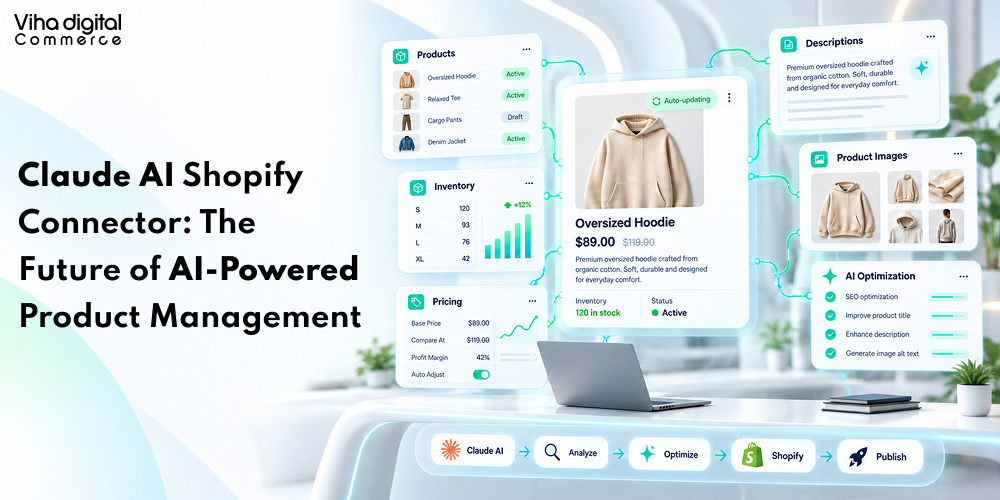
With a Claude AI Shopify Connector, merchants can connect Shopify with Claude AI and use natural language to work with store data and product information. Instead of manually navigating through multiple Shopify screens for every small task, teams can use AI to assist with product management and automate repetitive workflows.
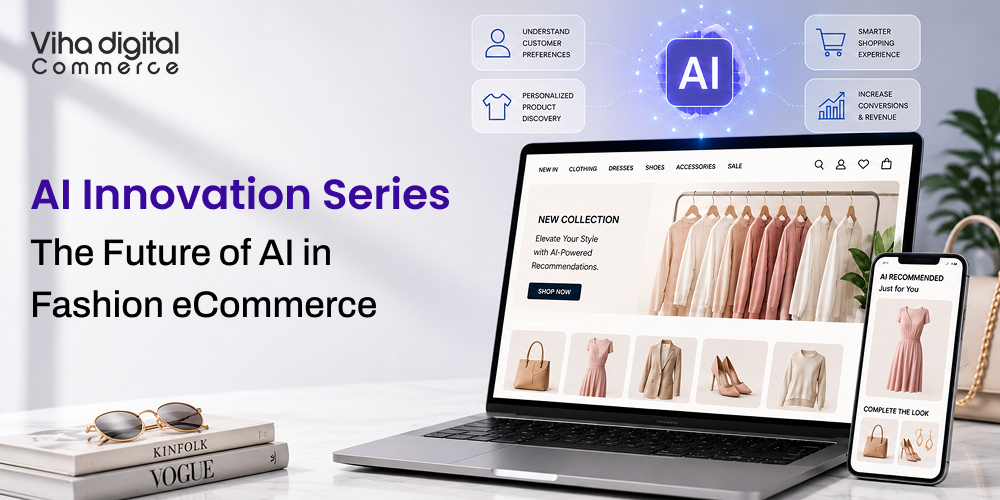
As part of Viha Digital Commerce’s AI Innovation Series, Episode 6 explores how Claude AI and Shopify can work together to create a smarter approach to ecommerce product management.
What Is a Claude AI Shopify Connector?
A connector creates a bridge between Claude AI and a Shopify store, allowing AI to interact with authorised Shopify data and functionality.
This means Claude can become more than a tool for generating text.
With the right integration, it can help ecommerce teams work with product information, product listings, variants, inventory data, and other store operations through natural language.
For example, instead of manually asking:
“Which products are currently out of stock?”
a merchant could ask Claude directly.
Similarly, a team could ask questions about product information or request assistance with updating and creating ecommerce content.
This is where Claude AI for Shopify becomes particularly interesting for merchants managing large or frequently changing catalogues.

From AI Content Generation to AI Product Management
AI has already changed how ecommerce businesses create content.
Businesses use AI to generate product descriptions, marketing copy, email content, social posts, and SEO information.
But product management requires much more than content generation.
A typical product listing can contain:
- Product name
- Description
- Images
- Pricing
- Variants
- SKU information
- Inventory
- Product tags
- SEO title
- Meta description
- Product category
- Additional attributes
Managing these elements individually across hundreds or thousands of products can consume significant time.
A Claude AI Shopify integration can help bring these activities into a more conversational workflow.
Instead of treating AI as a separate content-generation tool, businesses can use it as an intelligent layer that works alongside their Shopify store.
How to Create Shopify Products Using Claude AI
One of the most interesting possibilities is using AI to assist with product creation.
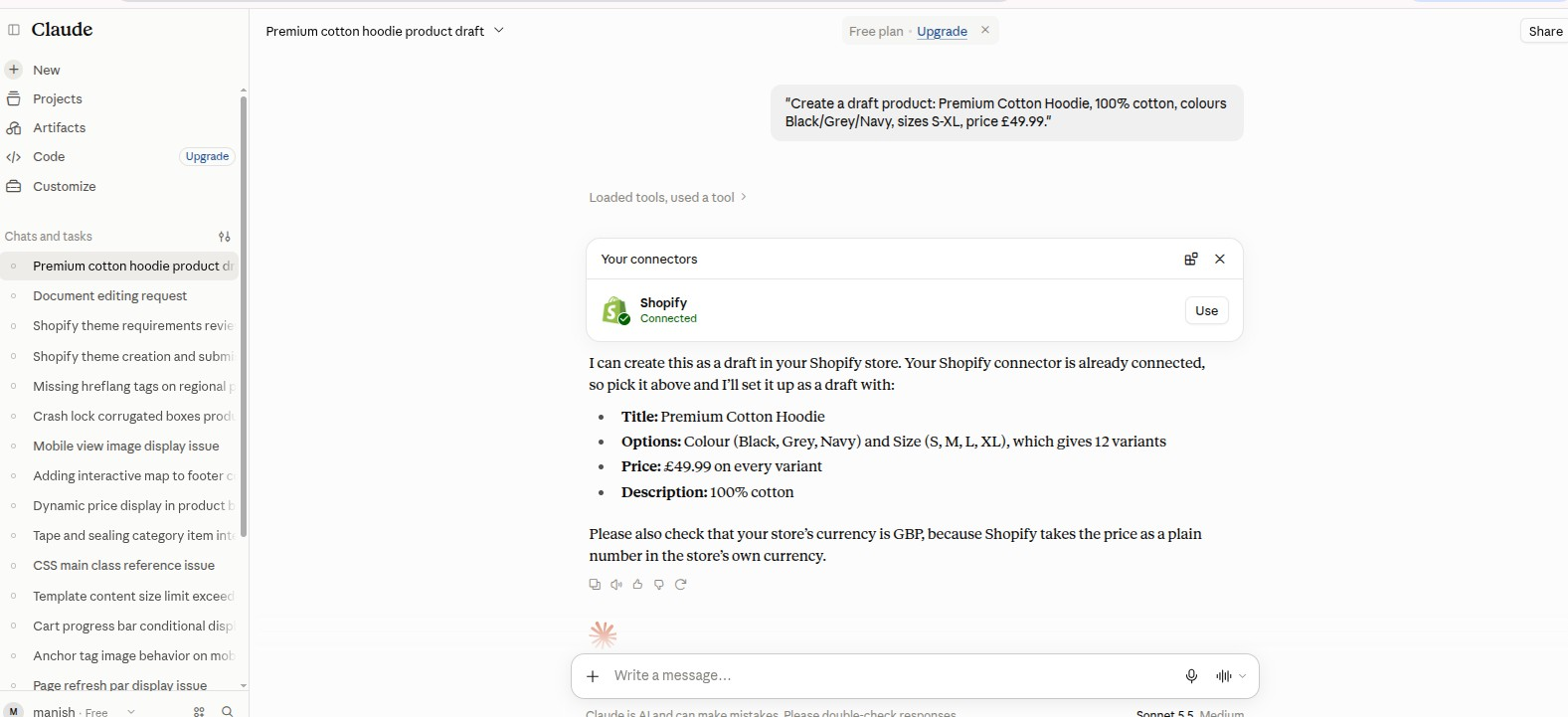
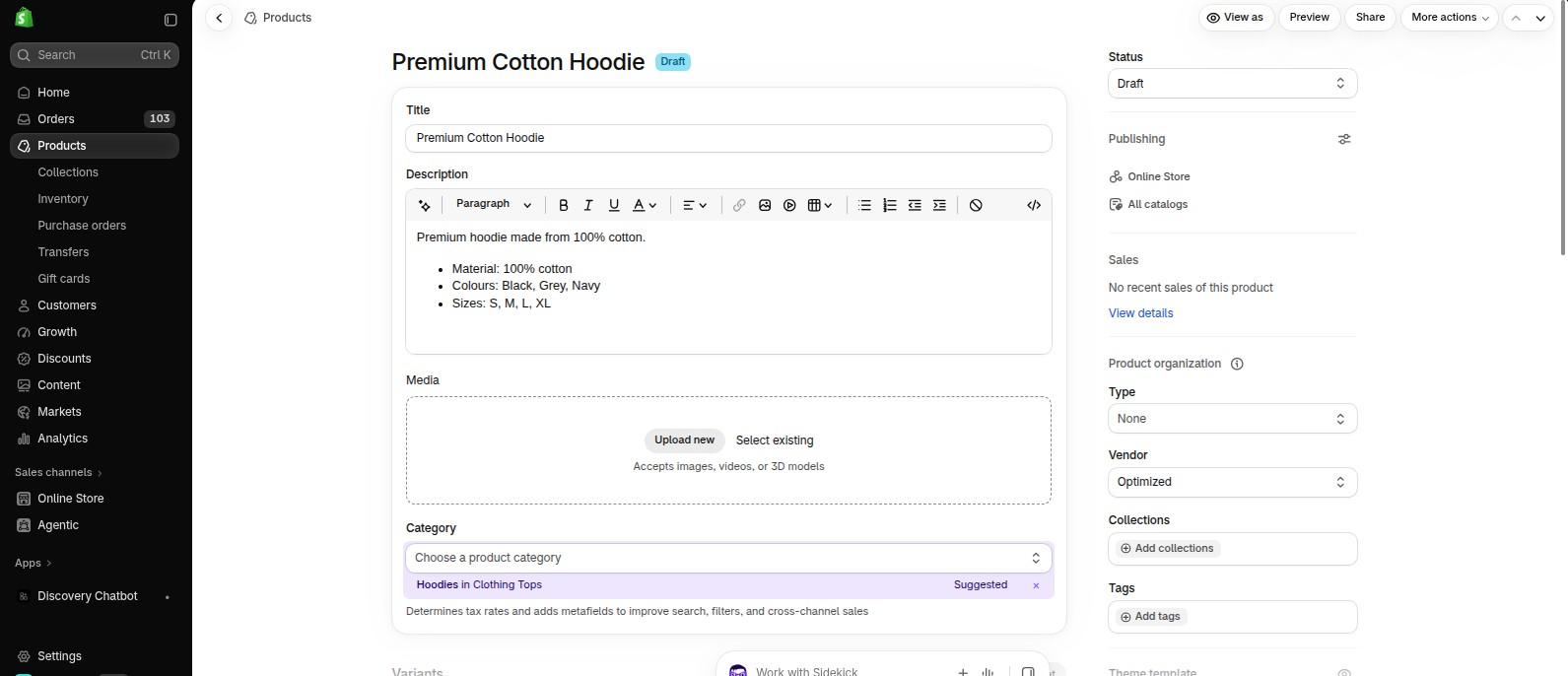
Imagine a merchant has a new product and provides Claude with basic information such as:
Product: Premium Cotton Hoodie
Material: 100% Cotton
Colours: Black, Grey, Navy
Sizes: S, M, L, XL
Price: £49.99
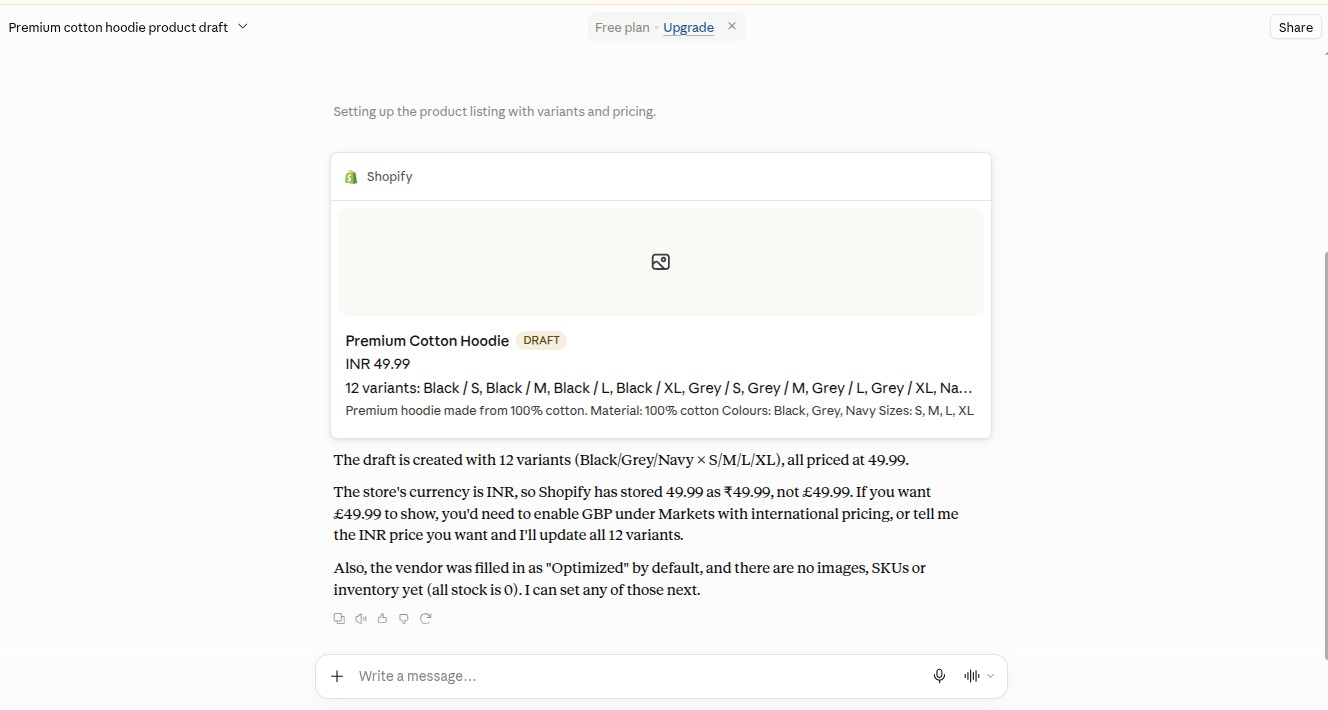
Instead of manually creating every field, the merchant could use Claude to help structure the information into a Shopify-ready product listing.
This can include a product title, description, product tags, SEO information, and variant structure.
This makes how to create Shopify products using Claude AI a much bigger question than simply asking AI to write a description.
The real opportunity is using AI to assist with the entire product creation workflow.
Claude AI for Shopify Product Descriptions
Product descriptions are one of the simplest areas where AI can immediately provide value.
With Claude AI for Shopify product descriptions, ecommerce teams can provide basic product information and generate consistent descriptions based on predefined brand guidelines.
For example, a business could establish rules for:
- Tone of voice
- Description length
- Product terminology
- Formatting
- Key selling points
- Target audience
- Brand language
Claude can then help create descriptions that follow those guidelines across large product catalogues.
This is especially useful when products share similar attributes but require unique descriptions.
The objective isn’t simply to produce more content.
It is to create consistent, useful, and scalable product content.
Automate Shopify Product Listing With AI
Creating individual product listings becomes increasingly difficult as a store grows.
A merchant managing 50 products might handle the process manually. A merchant managing 5,000 products has a completely different operational challenge.
This is where businesses can automate Shopify product listing with AI.
A connected AI workflow could help transform structured product information into Shopify-ready listings.
The workflow could look like:
Product Data → Claude AI → Content Generation → Shopify → Product Listing
Instead of manually entering every field, ecommerce teams can automate parts of the process while keeping humans involved where approval or validation is required.
This combination of automation and human oversight can make product management significantly more efficient.
Shopify Bulk Product Upload Using AI
Bulk catalogue management is another area where AI can make a significant difference.
A business launching hundreds of products may need to prepare product titles, descriptions, tags, SEO information, variants, and other attributes before uploading everything to Shopify.
With Shopify bulk product upload using AI, teams can use AI to prepare and structure product information before it reaches the store.
For example:
- Import product data.
- Analyse the information with Claude.
- Generate missing product content.
- Create consistent descriptions.
- Generate SEO fields.
- Structure variants.
- Review the generated information.
- Upload or update products in Shopify.
The result is a more scalable product-management workflow.
Generate Shopify SEO Titles and Meta Descriptions With AI
Product SEO is another area where ecommerce teams spend considerable time.
Every product may require an optimised title and meta description that accurately represents the product while remaining useful to search engines and customers.
Businesses can use AI to generate Shopify SEO titles and meta descriptions with AI based on product information and predefined SEO guidelines.
This can also support broader Shopify SEO automation, particularly when a store has thousands of products.
However, automation should not mean blindly generating content and publishing it.
AI-generated SEO content should still follow the brand’s SEO strategy, product data requirements, search intent, and quality standards.
Shopify AI Connector for Product Variants and Inventory
Product variants can become particularly complicated for large Shopify stores.
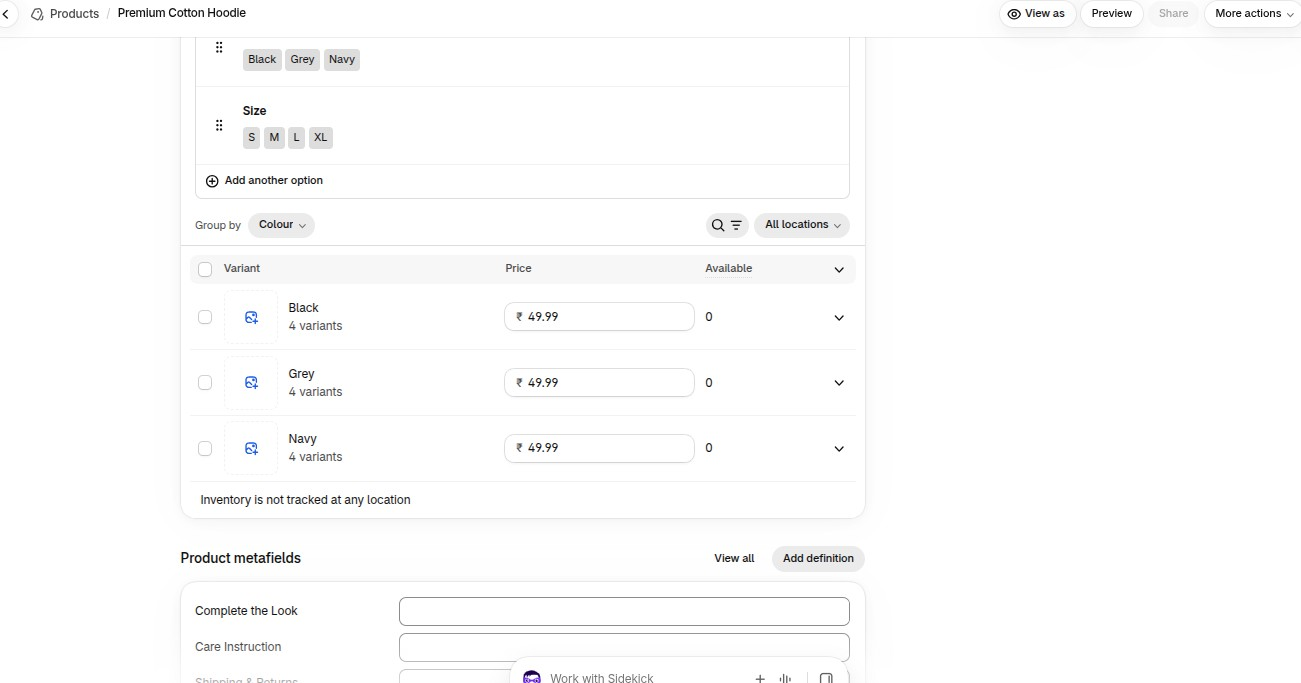
A single product may have dozens of combinations based on size, colour, material, configuration, or other attributes.
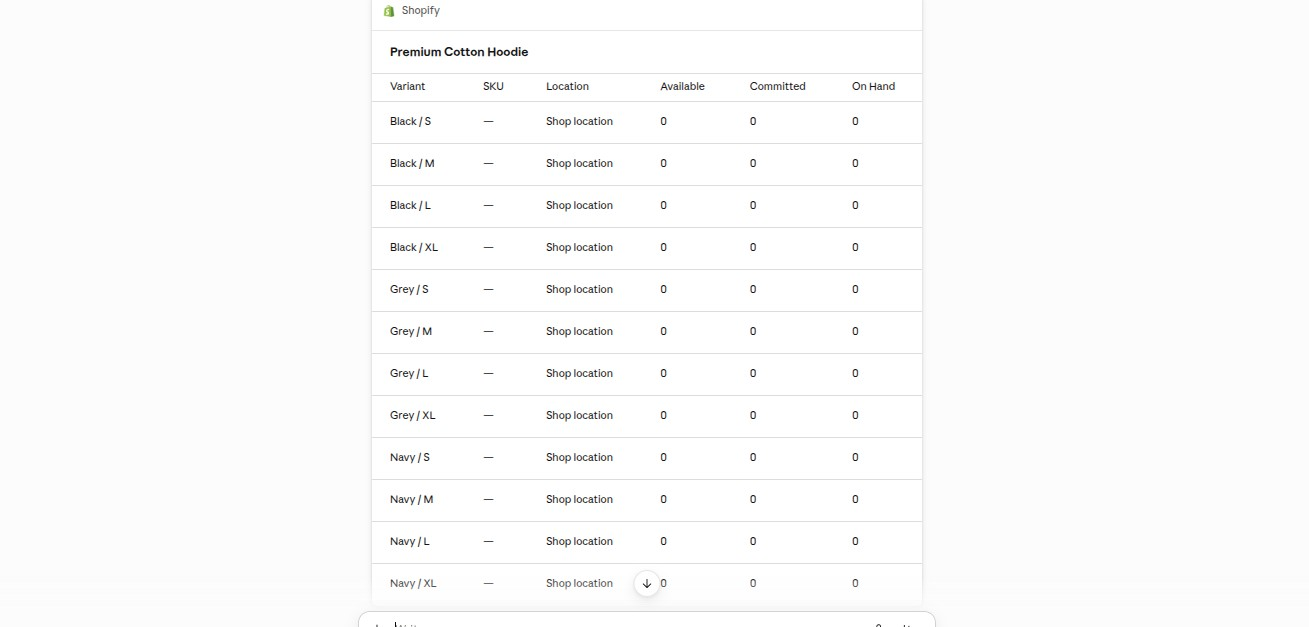
An effective Shopify AI connector for product variants and inventory can help teams work with this information more efficiently.
For example, merchants could use AI to identify products with missing variants, analyse inventory-related information, or assist with updating product data.
The exact capabilities depend on the permissions and functions available through the integration, but the underlying principle remains the same:
Instead of navigating through data manually, merchants can interact with their store using natural language.
Shopify AI Automation Is About More Than Chat
When people hear “AI for Shopify,” they often think about chatbots or content generation.
But Shopify AI automation can go much further.
AI can potentially support workflows across:
- Product management
- Content generation
- SEO
- Catalogue organisation
- Inventory-related tasks
- Product updates
- Data analysis
- Merchandising
- Customer experience
This is why AI Shopify automation is becoming an important area of ecommerce development.
The goal isn’t to replace ecommerce teams.
It is to remove repetitive manual work so teams can spend more time on strategy, merchandising, customer experience, and growth.
AI Tools for Shopify Store Management
There are already numerous AI tools for Shopify store operations, but the value of a tool depends on how well it connects with the merchant’s actual workflow.
A standalone AI tool can generate content.
A connected AI system can potentially understand store data, work with authorised systems, and help execute actions.
That distinction is important.
The future of Shopify AI isn’t necessarily about having another AI dashboard.
It is about bringing AI into the tools merchants already use.
Building a Smarter Shopify AI Integration
Implementing this type of system requires more than simply connecting an AI model to a Shopify store.
Businesses need to consider:
- Data permissions
- API access
- Security
- Authentication
- Workflow design
- Human approval
- Error handling
- Store-specific business rules
- AI response accuracy
- Monitoring and testing
This is where an experienced AI developer can make a significant difference.
Businesses looking to hire AI developers should look for teams that understand both AI technologies and ecommerce platforms.
The best results come from understanding the business workflow first and then determining where AI and automation can provide measurable value.
Why Businesses May Need an AI Ecommerce Development Company
AI implementation becomes more complex when businesses move beyond simple content generation.
An AI ecommerce development company for Shopify stores can help businesses identify repetitive processes, design AI-powered workflows, connect systems, and integrate automation into existing ecommerce infrastructure.
For businesses considering whether to hire an AI developer for Shopify automation or hire an AI developer for ecommerce website development, the key consideration should be the problem they want to solve.
AI should not be implemented simply because it is trending.
It should solve a real operational problem.
The Future of AI-Powered Product Management
The next generation of ecommerce management is likely to become increasingly conversational.
Instead of navigating through multiple dashboards, merchants could ask:
“Create a product listing using this supplier information.”
“Which products are missing SEO descriptions?”
“Show me products with low inventory.”
“Update these product descriptions using our new brand guidelines.”
“Create SEO titles for these products.”
The interface changes from clicking through systems to communicating with systems.
That is the bigger potential behind Claude AI and Shopify integration.
Frequently Asked Questions
1. What is a Claude AI Shopify Connector?
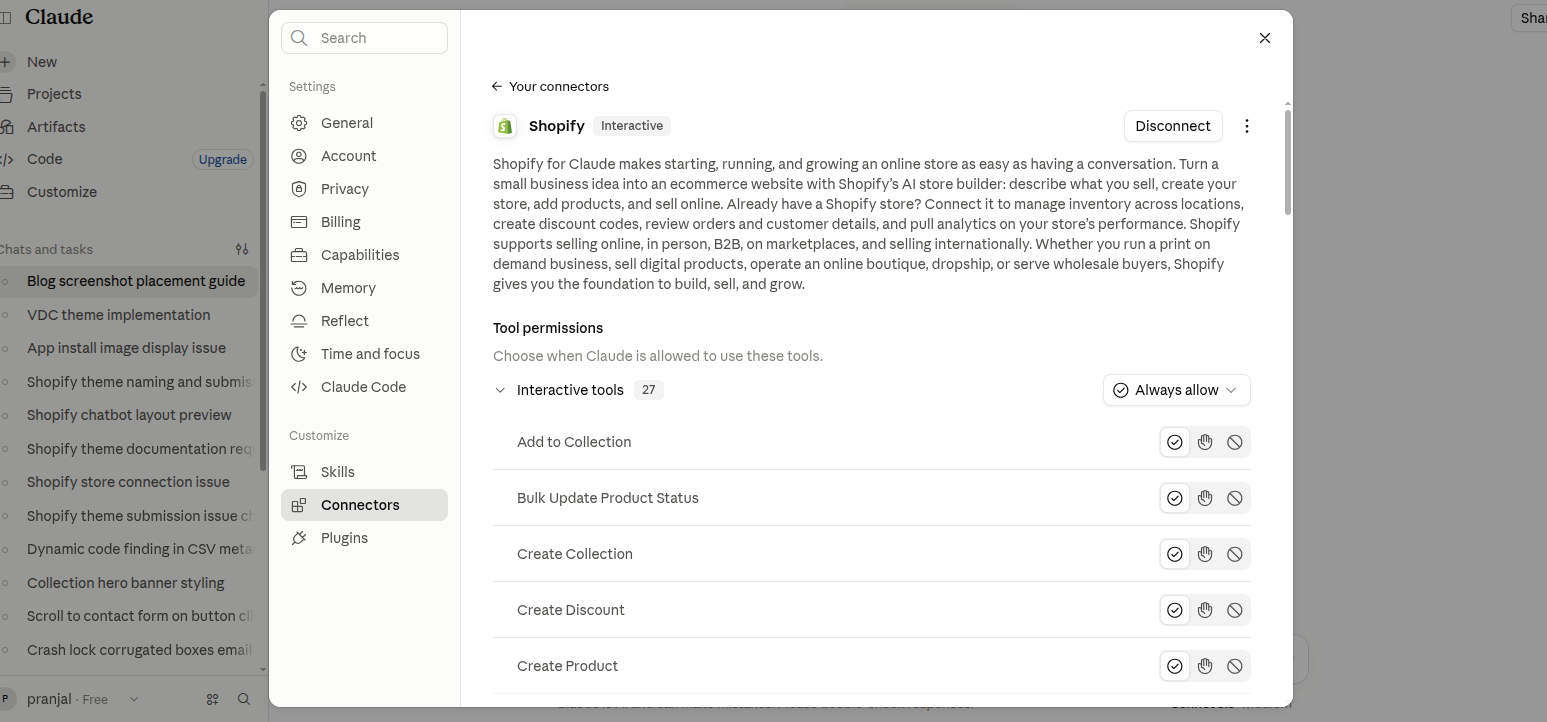
A Claude AI Shopify Connector connects Claude AI with a Shopify store, allowing merchants to use natural language to manage and work with authorised store data. Depending on the permissions provided, merchants can create and update products, manage inventory, organise collections, and analyse store information.
2. Can Claude AI create Shopify products?
Yes. The Shopify connector for Claude can create products with information such as titles, descriptions, prices, variants, options, and inventory tracking. Merchants can provide the required product information through natural-language instructions.
3. How can Claude AI help with Shopify product descriptions?
Claude AI can help generate and update product descriptions based on the information and instructions provided by the merchant. Businesses can establish brand guidelines, tone, formatting, and product requirements to create more consistent product content across their catalogue.
4. Can I automate Shopify product management with AI?
AI can automate or assist with several Shopify product-management tasks, including creating and updating products, managing product information, organising collections, and working with inventory. The exact actions available depend on the connector’s permissions and supported functionality.
5. Can Claude AI manage Shopify product variants?
Yes. The Shopify connector for Claude can create products with variants and options and can update variant-related information such as prices and SKUs. This can help merchants manage products with multiple sizes, colours, or configurations.
6. Can Claude AI manage Shopify inventory?
Yes. The connector can read inventory levels for product variants and set available stock quantities at specific locations when the required access has been authorised.
7. Can Claude AI generate Shopify SEO titles and meta descriptions?
Claude can assist with creating SEO-focused product titles and descriptions based on product information and defined SEO guidelines. Businesses should review AI-generated content before publishing it to ensure accuracy, relevance, and alignment with their SEO strategy.
8. Is Claude AI useful for Shopify bulk product management?
Yes. AI can help ecommerce teams work more efficiently with large product catalogues by assisting with product creation, updates, descriptions, variants, collections, and other repetitive product-management tasks. However, some connector actions have limits on how many products can be changed at once.
9. What are the benefits of Shopify AI automation?
Shopify AI automation can reduce repetitive manual work, improve consistency across product data, accelerate catalogue management, and help ecommerce teams spend more time on merchandising, strategy, and customer experience.
10. Is Claude AI the same as Shopify’s built-in AI tools?
No. Claude is a third-party AI platform, while Shopify also provides its own AI features, including Sidekick. Shopify allows merchants to connect third-party AI tools such as Claude to their stores, with the merchant controlling the data access and permissions granted to the tool.
11. Is a developer required for Claude AI Shopify integration?
The official Shopify connector for Claude can be installed and authorised without building a custom integration from scratch. However, businesses looking for advanced workflows, custom automation, complex integrations, or specialised AI ecommerce solutions may benefit from working with an experienced AI developer or ecommerce development company.
12. Is it safe to connect Claude AI to a Shopify store?
Merchants control the data access and permissions granted to a connected AI tool. However, businesses should review the requested permissions, the AI provider’s terms and privacy policy, and any applicable data-protection requirements before connecting their store. Shopify also recommends reviewing AI-generated changes before relying on them.
13. Can Claude AI completely replace Shopify Admin?
No. The Shopify connector can assist with many store-management tasks, but Shopify Admin remains the primary platform for managing the store. Some settings and actions are not available through the connector, including certain payment, tax, domain, theme, and order-related operations.
14. How can businesses implement AI ecommerce development for Shopify?
Businesses can start by identifying repetitive ecommerce processes that could benefit from AI, such as product management, SEO content, catalogue updates, inventory workflows, and data analysis. An experienced AI ecommerce development team can then design and implement workflows around those specific requirements.
Conclusion
The Claude AI Shopify Connector represents a shift in how merchants can think about AI-powered ecommerce management.
Instead of using AI only to write content, businesses can explore how AI can work with their Shopify store to support product creation, catalogue management, SEO, variants, inventory workflows, and other repetitive operations.
From automate Shopify product listing with AI to generating SEO content and managing large catalogues, the possibilities extend far beyond traditional AI content generation.
At Viha Digital Commerce, we help businesses explore and implement AI-powered ecommerce solutions across Shopify and other platforms. From AI ecommerce development and Shopify integrations to custom automation and intelligent workflows, our focus is on turning AI capabilities into practical business solutions.
The future of ecommerce management isn’t just about having AI.
It’s about giving AI the ability to work with your ecommerce business.









 All-in-One Solution
 Customizable Services
 Assortment of Payment Options
 Optimized Sales Processes
 Omnichannel Maintenance & Support
 Custom Shopping Cart
 Advanced Security & Support
 API Payment & Logistic Integrations
 Social Media Integration
 Professional Communication
 Skilled Developers
 Timing is Everything
 Secure Agreements
 Support Tilt
 Quality Top Up Most
 White Development Pathway
 Competitive Price Point