SaaS vs PaaS Explained: The Key Differences Every Business Owner Must Know
Cloud computing has completely reshaped how modern businesses operate, scale, and innovate. But when it comes to choosing between SaaS vs PaaS vs IaaS, most business owners find themselves stuck in a maze of technical jargon and unclear comparisons.
This guide breaks it down in a sharp, practical way, so you don’t just understand the types of cloud computing SaaS PaaS IaaS, but actually know which one fuels your business growth.
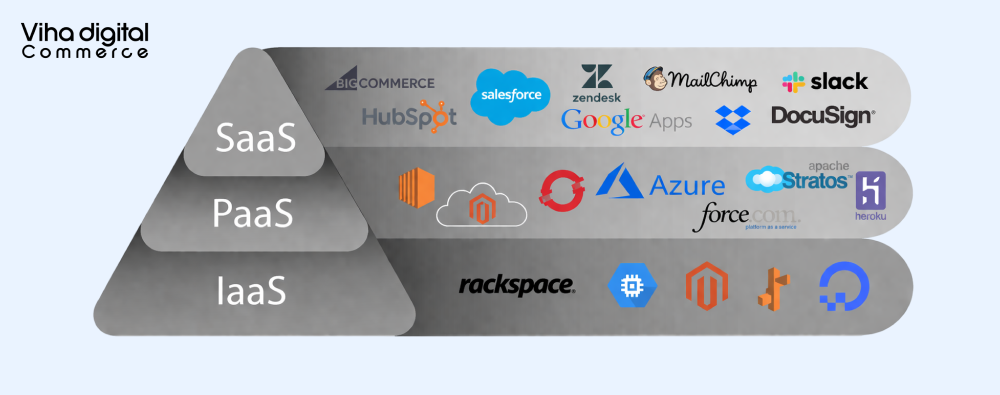
Types of Cloud Services: IaaS vs PaaS vs SaaS
Before diving deep, let’s establish the foundation.
| Cloud Model | What You Get | Who Manages What | Best For |
| IaaS (Infrastructure as a Service) | Servers, storage, networking | You manage OS, apps, data | Tech-heavy teams needing full control |
| PaaS (Platform as a Service) | Platform + tools to build apps | Provider manages infra, you manage apps | Developers & custom solutions |
| SaaS (Software as a Service) | Ready-to-use software | Provider manages everything | Businesses needing speed & simplicity |
Quick stat:
Over 70% of businesses today rely on SaaS solutions for core operations, while PaaS adoption is growing rapidly in custom application development environments.
What is SaaS (Software as a Service)?
SaaS is the plug-and-play model of cloud computing. You don’t build, you don’t maintain, you simply log in and use.
Think of platforms like Shopify or Google Workspace.
SaaS in Depth: The Turn-Key Solution
SaaS removes all the heavy lifting. No infrastructure headaches, no updates, no security patches, everything is handled.
Key Characteristics of SaaS
- Fully hosted and managed by the provider
- Accessible via browser (no installations needed)
- Subscription-based pricing
- Automatic updates and security handling
- Scalable with minimal effort
Pros and Cons of SaaS
Pros:
- Fastest time-to-market
- No technical expertise required
- Lower upfront costs
- High reliability and uptime
Cons:
- Limited customization
- Dependency on vendor
- Less control over backend processes
What is PaaS (Platform as a Service)?
PaaS sits right in the middle, giving you control without complexity.
It provides a framework where developers can build, customize, and deploy applications without worrying about infrastructure.
PaaS in Depth: The Customisation Powerhouse
PaaS is ideal when your business needs flexibility and scalability without going fully raw like IaaS.
Example: Adobe Commerce (formerly Magento Commerce) operates as a powerful PaaS-based solution.
Key Characteristics of PaaS
- Built-in development tools and frameworks
- Managed infrastructure
- High scalability and flexibility
- Custom application development support
- Integration-friendly architecture
Pros and Cons of PaaS
Pros:
- High customization capability
- Faster development cycles
- Reduced infrastructure management
- Ideal for complex applications
Cons:
- Requires technical expertise
- Higher development costs than SaaS
- More responsibility than SaaS
Key Differences: SaaS vs PaaS
Let’s break down the difference between SaaS and PaaS in a way that actually matters for decision-making.
| Factor | SaaS | PaaS |
| Control | Minimal | Moderate to High |
| Customization | Limited | Extensive |
| Setup Time | Immediate | Moderate |
| Technical Skill Required | Low | Medium to High |
| Cost Structure | Subscription-based | Development + hosting costs |
| Flexibility | Low | High |
Insight:
The saas and paas difference boils down to this:
SaaS = Convenience
PaaS = Control
Who Should Use SaaS, and Who Should Use PaaS?
Choose SaaS if:
- You want to launch quickly
- You don’t have a technical team
- Your requirements are standard
- You prioritize ease of use
Choose PaaS if:
- You need deep customization
- You have a development team
- Your business model is complex
- You want scalability without limits
SaaS vs PaaS in the eCommerce Context
This is where things get real, because the saas vs paas debate directly impacts revenue, scalability, and customer experience.
SaaS in eCommerce: Shopify
Shopify is the perfect example of SaaS dominance in eCommerce.
Why businesses choose Shopify:
- Launch store in days, not months
- No hosting or maintenance worries
- Built-in payment, shipping, and apps
- Easy for non-technical founders
Stat:
Shopify powers millions of businesses globally, making it one of the most dominant SaaS eCommerce platforms.
But here’s the trade-off:
Customization is limited. You work within Shopify’s ecosystem.
PaaS in eCommerce: Adobe Commerce (Magento)
Adobe Commerce represents the power of PaaS.
Why businesses choose Adobe Commerce:
- Fully customizable architecture
- Advanced B2B and enterprise features
- Deep integrations with ERP, CRM, and APIs
- Scalable for high-growth businesses
Stat:
Magento-based platforms power a significant portion of mid-to-enterprise-level eCommerce businesses worldwide, especially those with complex catalogs and workflows.
Trade-off:
You need Magento developers, but the payoff is complete control.
Compare PaaS and SaaS for eCommerce
| Feature | Shopify (SaaS) | Adobe Commerce (PaaS) |
| Setup Speed | Very fast | Moderate |
| Customization | Limited | Extensive |
| Cost | Predictable monthly | Variable (dev + infra) |
| Scalability | Good | Excellent |
| Flexibility | Restricted | Unlimited |
| Best For | Startups, SMBs | Mid-market, Enterprise |
Characteristics of PaaS and SaaS (Quick Recap)
| Feature | SaaS | PaaS |
| Hosting | Fully managed | Managed |
| Development | Not required | Required |
| Control | Low | Medium–High |
| Maintenance | None | Partial |
| Use Case | Ready solutions | Custom builds |
How Viha Digital Commerce Can Help You Choose and Implement
This isn’t just about compare PaaS and SaaS, it’s about choosing what actually drives your business forward.
That’s where Viha Digital Commerce steps in.
What we do:
- Deep business analysis to identify the right model
- Shopify (SaaS) store setup and optimization
- Adobe Commerce development and scaling
- Performance optimization and integrations
- Migration between platforms without data loss
Why it matters:
Choosing the wrong cloud model can cost you time, money, and scalability.
Choosing the right one?
That’s how you dominate your market.
Final Take
If you remember just one thing from this entire breakdown of saas vs paas:
- SaaS is speed and simplicity
- PaaS is power and flexibility
- IaaS is raw control
The real question isn’t which is better,
It’s which one aligns with your ambition.







 All-in-One Solution
 Customizable Services
 Assortment of Payment Options
 Optimized Sales Processes
 Omnichannel Maintenance & Support
 Custom Shopping Cart
 Advanced Security & Support
 API Payment & Logistic Integrations
 Social Media Integration
 Professional Communication
 Skilled Developers
 Timing is Everything
 Secure Agreements
 Support Tilt
 Quality Top Up Most
 White Development Pathway
 Competitive Price Point