
Why 1 in 4 Top-Ranking Pages Got Wiped Out by Google’s March 2026 Update
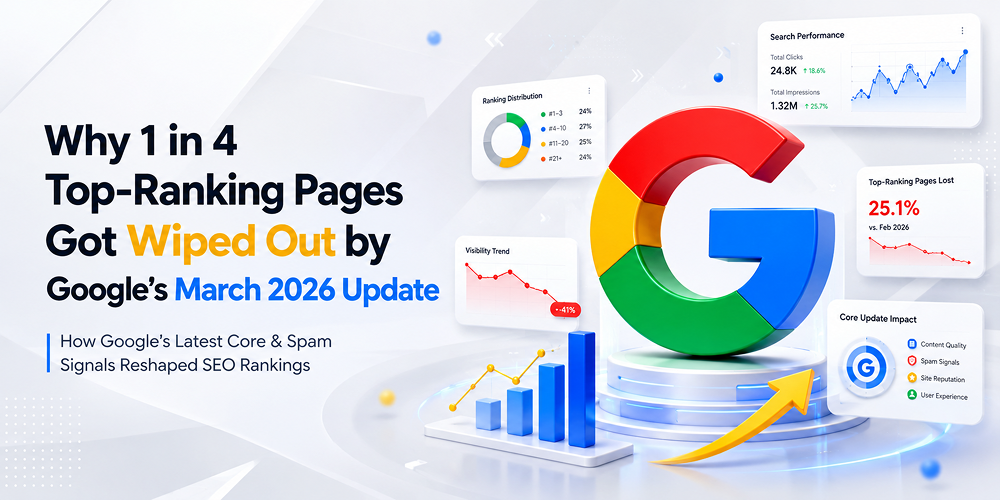
Google’s March 2026 Core Update was not a routine reshuffle. It was one of the most disruptive ranking events in recent search history — and if your eCommerce store has seen a sudden drop in organic traffic, this post breaks down exactly what happened, why it happened, and what the data tells us about where Google is heading next.
24%
of top-10 pages fell
completely out of the
top 100
9.5/10
Peak SEMrush Sensor
volatility score —
among the highest on
record
55%
of monitored websites
saw noticeable ranking
changes within 2 weeks
What Is the Google March 2026 Core Update?
On March 27, 2026, Google launched its first broad core algorithm update of the year. The rollout completed on April 8, 2026 — lasting 12 days and 4 hours. Google described it as “a regular update designed to better surface relevant, satisfying content for searchers from all types of sites.”
But the data told a different story. This was anything but routine. The update followed directly on the heels of the March 2026 Spam Update (March 24–25), which completed in under 20 hours — the shortest confirmed spam update in Google’s history. The overlap of two major updates within 48 hours amplified volatility across every ranking tier and made attribution significantly more complex for site owners.
MARCH 24–25, 2026
March 2026 Spam Update completes in under 20 hours.
Targets link schemes, cloaking, and AI-generated spam content.
MARCH 27, 2026
March 2026 Core Update begins rolling out globally.
Rankings start shifting immediately.
APRIL 8, 2026
Core Update rollout confirmed complete.
55%+ of monitored websites affected.
The Volatility Data: By the Numbers
Using data from SE Ranking, SEMrush Sensor, and SISTRIX, independent researchers analysed ranking changes across 100,000 keywords before and after the update. The results confirmed this was the most volatile core update since at least December 2025.
“Strong brands, owned data, and direct query value won.
Intermediaries now look increasingly exposed.”
— Search Engine Land, April 2026
Who Lost Rankings? (Winners & Losers)
By analysing SISTRIX Visibility Index data across 2,076 unique domains, researchers identified clear patterns in who gained and who lost organic visibility. The results reveal a deliberate reordering of the search landscape.
- Government & official institutions
- Direct brand websites
- Specialist niche publishers
- Pages with original research & data
- Sites with verified author credentials
- eCommerce stores with strong E-E-A-T signals
- YouTube (largest single visibility drop recorded)
- Reddit, Instagram & X (UGC platforms)
- Aggregator & comparison sites
- Thin affiliate content hubs
- Wikipedia & reference aggregators
- Sites with anonymous or weak authorship
The single most striking individual story was YouTube: a drop of over 567 SISTRIX visibility points — roughly 30% larger than Wikipedia’s record-breaking decline in December 2025. YouTube, Reddit, Instagram, and X — the four pillars of the UGC surge that dominated SERPs from 2023–2025 — all posted significant losses, signalling that Google is course-correcting its heavy reliance on social and community-driven results.
Why Pages Got Wiped Out — The Real Reasons
Thin Content & Lack of E-E-A-T
The March 2026 update intensified pressure on pages that exist primarily to capture keyword traffic without providing genuine informational value. Google’s systems are now more aggressively evaluating content against four dimensions of quality: Experience, Expertise, Authoritativeness, and Trustworthiness (E-E-A-T).
Pages most at risk: templated “best of” roundups, copied comparison angles, thin coupon pages, and location-based landing pages built from identical frameworks. These weren’t penalised because of affiliate links or monetisation — they were deprioritised because their informational contribution was weak relative to competing pages.
Product category pages and blog content that simply restate manufacturer information — without adding first-hand insight, product comparisons, or original data — are highly vulnerable to future core updates. If your page says what every other page says, keyword placement alone will not save it.
⚠️ Weak Intent Alignment
A significant driver of ranking losses was intent misalignment — pages targeting keywords without fully satisfying the actual user journey behind those searches. Google is now evaluating pages comparatively against competing results in real time, not just in isolation.
Pages that ranked on narrow keyword targets without addressing the full context of user intent — the questions before the question, the next step after the answer — saw the most severe drops. This is particularly relevant for eCommerce, where product and category pages often optimise for transactional terms while neglecting the informational queries that precede purchase decisions.
⚠️ UGC & Aggregator Sites Hit Hard
Reddit, Quora, and YouTube had seen massive ranking boosts from 2023 onwards as Google prioritised discussion-heavy, community-driven results. The March 2026 update appears to represent a deliberate correction: UGC still ranks when it is genuinely the best answer for a query, but has lost the broad preferential treatment it received over the past two years.
For eCommerce businesses, this opens a significant window. Comparison and review content that was previously being outranked by Reddit threads or YouTube videos may now have a genuine opportunity to reclaim top positions — if the content demonstrates real expertise and original value.
What Google Is Rewarding Now
The patterns across winners from the March 2026 update reveal a clear picture of what Google’s systems are increasingly rewarding:
Source authority over intermediary aggregation Google is routing users to natural endpoints rather than sites standing between a user and an answer.
Original contribution first-hand testing, proprietary data, unique case studies, expert synthesis, or genuine opinion — content that cannot be replaced by a more direct source.
Credentialed authorship named authors with verifiable credentials and experience in their subject area, not generic “editorial teams.”
Technical health as a foundation Core Web Vitals are now evaluated holistically as a composite score; failing one metric carries compounded penalties.
Topical depth over breadth sites that own a subject area comprehensively outperform those producing broad, shallow content across many topics.
Clear intent satisfaction content that fully addresses the user journey, not just the surface-level keyword.
How to Check if Your Site Was Affected
Before making any changes to your site, confirm whether your traffic drop is actually caused by the March 2026 Core Update. Follow this diagnostic process:
Check Your Google Search Console Data
Go to Performance → Search Results. Set your date range to compare March 27 onwards vs. the same period 4 weeks prior. If clicks and impressions dropped specifically around March 27–28, the Core Update is the likely cause.
Identify Affected Page Types — Not Just Keywords
Look for page-level declines rather than individual keyword drops. Group affected pages by type: product pages, category pages, blog content, landing pages.
Wait for Stabilisation Before Acting
Google recommends waiting at least 7–10 days after full rollout before drawing conclusions. Making sweeping changes during or immediately after a rollout often creates more damage.
Prioritise Revenue-Generating Pages First
Focus your audit on the 5–10 pages that have both dropped meaningfully and carry the highest commercial value.
How to Recover from the March 2026 Core Update
Google is consistent in its core guidance: recovery from a broad core update does not happen instantly. Sites typically recover in one of two ways — through natural settling of the algorithm (for temporary volatility-driven drops), or through substantive content improvement recognised at the next major core update, expected in June or July 2026.
That gives you a focused window. Here is what to prioritise:
Conduct a content audit with a single central question: Does this page add something genuinely new compared to the top 5 results for its target keyword? If you cannot identify at least 2–3 unique elements — original data, a real case study, first-hand experience, a unique expert perspective — the page needs substantive improvement, not just a rewrite.
Strengthen E-E-A-T signals immediately: Add named authors with real credentials on every article. Include author bios with LinkedIn profiles, years of experience, and specific expertise claims. Add verifiable sources and site original data wherever possible.
Audit intent alignment page by page: Open each affected page alongside its top 3 ranking competitors and assess honestly: does your page satisfy the complete user journey for its target query, or does it address only the surface-level keyword?
Resolve Core Web Vitals failures on mobile: The March 2026 update introduced holistic CWV scoring. Failing even one metric now carries compounded penalties — treat LCP, INP, and CLS as a composite priority, not individual checkboxes.
Consolidate thin content: Identify similar articles targeting overlapping topics and merge them into a single, comprehensive, authoritative piece rather than maintaining multiple weak pages competing against each other.
Do not make panic edits: Do not stuff pages with new keywords, change publish dates without materially updating content, or assume every drop is a technical issue. Core updates reward real improvement over reactive activity.
The May 2026 Update: What’s Changed Right Now
While sites were still stabilising from the March 2026 Core Update, Google followed up with additional ranking refinements in May 2026 — confirming that the search giant is now operating on a near-continuous cycle of system-level adjustments rather than isolated, discrete events.
Google’s May 2026 refinements are actively reshaping rankings as of this writing. If your site recovered partially from the March update but has seen fresh fluctuations since early May, these changes are the likely cause. The impact is compounding on sites that did not fully address March’s signals.
What the May 2026 Update Targets Based on observed ranking patterns and Google’s ongoing quality documentation, the May 2026 changes intensify three areas that the March Core Update introduced:
Enhanced Search Intent Recognition: Google’s natural language processing has grown significantly more precise at reading the real need behind a query — not just the surface-level keyword. Context now outranks keyword density. Pages that were built around keyword clusters without genuinely satisfying the full user journey are losing ground.
Stricter AI Content Scrutiny: The May 2026 refinements apply a sharper filter to AI-generated material. AI-assisted content must now carry clear author expertise and verifiable first-hand experience to rank competitively.
Stricter Core Web Vitals Thresholds: The holistic CWV scoring introduced in March now has firmer individual benchmarks. LCP must now load in under 2 seconds to meet Google’s “good” threshold.
LCP threshold tightened: 2-second hard ceiling (down from 2.5s) • CLS ceiling: 0.1 or below required • AI content: E-E-A-T signals now mandatory, not optional • YMYL pages (health, finance, eCommerce checkout) facing the highest content quality thresholds of any update cycle to date • Mobile usability now a direct ranking factor across all page types, not just mobile queries
What May 2026 Means for eCommerce Specifically
For eCommerce businesses, the May refinements are particularly consequential in three areas:
Product pages with thin manufacturer descriptions are being systematically outranked by pages that add real comparative value — buyer guides, use-case breakdowns, first-hand testing notes, or customer insight integration.
YMYL category pages anything touching health products, financial services, supplements, medical devices, or high-value purchases — face the highest content quality thresholds. Generic copy will not survive the next full core update window.
Mobile page experience is now non-negotiable. Sites that haven’t fully resolved mobile CWV failures since the July 2025 Page Experience update are facing compounded penalties under May’s composite scoring — the cumulative effect is measurably larger than either update alone.
“Google is no longer running isolated updates — it is running a
continuous quality evaluation. Every month of inaction is a month
your competitors use to pull ahead.”
— SEO Vendor, May 2026
March + May Together: The Compound Effect
The critical insight for site owners in May 2026 is that these two update cycles are not independent events — they are compounding. A site that absorbed partial losses in March, delayed recovery action, and then encountered May’s refinements is now operating with a double deficit: reduced authority signals from March combined with freshly downweighted intent alignment from May.
Sites that moved quickly to improve E-E-A-T, resolve CWV failures, and realign content to user intent in April are seeing stabilisation and in some cases meaningful recovery. Sites that waited are facing compounded losses heading into the June/July core update window — the highest-risk period of 2026.
What to Expect Next (June 2026 Update Prediction)
Based on Google’s established cadence of core updates approximately every 90 days, the next broad core update is highly probable in June or July 2026. Historical data also suggests that Q3 (August–September) typically produces the most volatile update window of the year.
Several focus areas are increasingly likely to feature in upcoming updates, based on Google’s stated quality priorities and observed patterns from the March rollout:
Deeper AI content differentiation: Google is increasingly distinguishing between AI-assisted content produced with genuine human oversight and AI-generated content
published without substantive editorial input. The line is getting sharper.
Stronger user engagement signals: Time on page, scroll depth, return visits, and low bounce rates are expected to carry greater weight as proxies for genuine content satisfaction.
Entity-based authority: Verified author and organisation entities are increasingly influencing how topical authority is assigned — making author credibility infrastructure a strategic priority, not a cosmetic one.
AI Overview expansion: Google’s AI-generated search summaries continue to expand into more query types, further redistributing click volume even when rankings hold steady.
The sites that consistently gain from algorithm updates share a
common trait: they invest in quality, performance, and authentic
authority signals ahead of each cycle — not in reaction to them.
Is Your Store Losing Ground in March & May 2026?
At Viha Digital Commerce, we help eCommerce brands on Magento,
Shopify, and WooCommerce build SEO strategies designed to perform
through algorithm volatility — not scramble after it.
Deep Content Audits
We identify which pages need E-E-A-T improvements,
intent realignment, or consolidation.
Technical SEO Foundation
Core Web Vitals, crawlability, mobile performance,
and site architecture built for Google quality.
Authority-First Strategy
Topical depth, credible authorship, and link-building
strategies designed to compound.
Schedule a Free Strategy Call →
No commitment. We’ll analyse your site’s update impact and outline a clear recovery roadmap.












 All-in-One Solution
 Customizable Services
 Assortment of Payment Options
 Optimized Sales Processes
 Omnichannel Maintenance & Support
 Custom Shopping Cart
 Advanced Security & Support
 API Payment & Logistic Integrations
 Social Media Integration
 Professional Communication
 Skilled Developers
 Timing is Everything
 Secure Agreements
 Support Tilt
 Quality Top Up Most
 White Development Pathway
 Competitive Price Point