
ChatGPT Ads: What They Are, What They Cost, and Why Your Brand Should Be There
For the first time since ChatGPT launched, brands can now pay to appear inside it. OpenAI switched on advertising within ChatGPT in February 2026, and by May 2026 it opened a fully self-serve Ads Manager to businesses across the US, with access expanding to markets including the UK, Canada, Australia, Brazil, and Japan shortly after.
In a matter of months, this went from an invite-only pilot reserved for six-figure enterprise budgets to a channel almost any business can test. At Viha Digital Commerce, we believe this is one of the most significant shifts in performance marketing since the early days of Google Ads, and brands that move early stand to gain a real advantage.
Here’s what ChatGPT Ads actually are, how the features and pricing work, why this channel deserves a place in your 2026 media plan, and how our team can help you get it right from day one.
What Are ChatGPT Ads?
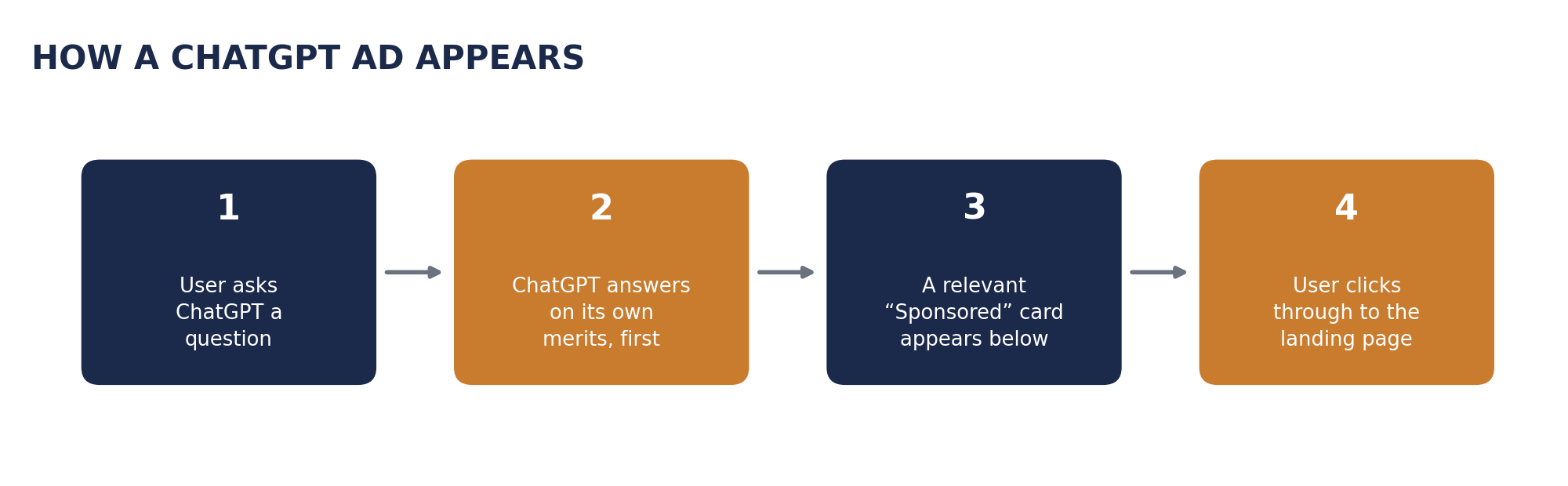
ChatGPT Ads are sponsored placements that appear below ChatGPT’s response to a user’s question, clearly labelled “Sponsored” and visually separated from the AI-generated answer. Each ad unit includes the advertiser name, logo, a headline, a short description, an image, and a link to the advertiser’s landing page. For product-related queries, some categories can also show a shopping-style card with pricing and availability, similar to what Etsy and Shopify have already piloted on the platform.
Crucially, ads never influence the model’s actual answer. ChatGPT responds to the user’s question first, on its own merits, and a relevant sponsored placement follows afterwards as a separate element. OpenAI has been explicit that ad selection does not shape or bias the generated response itself, which keeps the user experience trustworthy while still creating a genuine advertising opportunity.
Who Sees These Ads?
Ads only appear to users on ChatGPT’s Free tier and the low-cost Go tier. Anyone subscribed to Plus, Pro, Business, Enterprise, or Education never sees an ad, and OpenAI does not show ads to any account it identifies as belonging to a user under 18. That still leaves an enormous pool of reach: ChatGPT has several hundred million weekly active users, and the overwhelming majority sit on the ad-supported Free tier.
Key Features of ChatGPT Ads
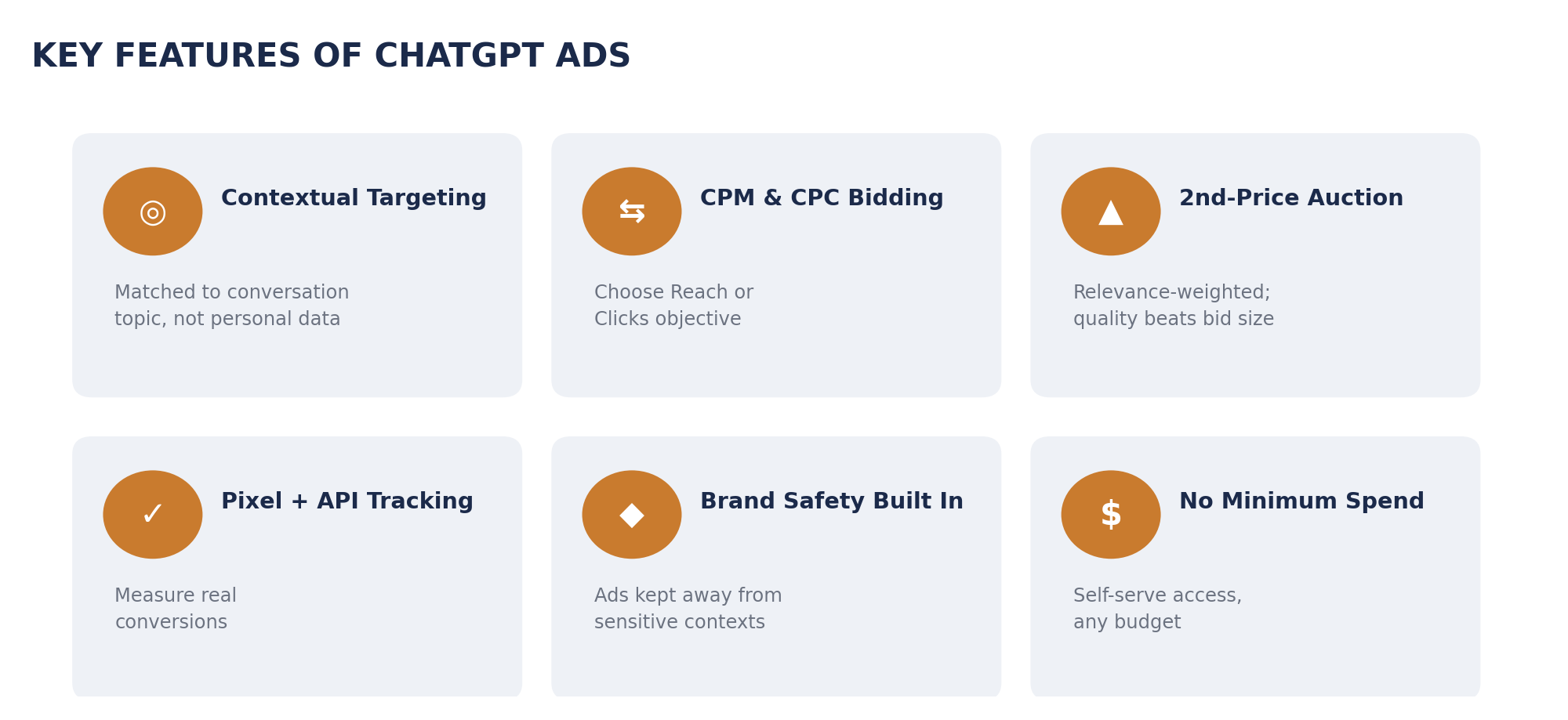
- Contextual, not creepy, targeting: Ads are matched primarily to the topic and intent of the current conversation. Advertisers set “context hints” describing the topics, products, or keywords relevant to them, rather than picking exact-match keywords. When ads personalisation is switched on, the system may also factor in signals from a user’s broader ChatGPT activity, but advertisers never see individual chats, personal details, or conversation history.
- Two bidding models: Advertisers choose between a Reach objective (pay per 1,000 impressions, CPM) or a Clicks objective (pay per click, CPC), depending on whether the goal is visibility or direct response.
- Relevance-weighted, second-price auction: Ad ranking blends bid amount with expected relevance and quality, much like Google’s Quality Score. A well-matched, well-built ad can outrank a higher bid from a less relevant competitor, and winners typically pay only slightly more than the next-best bid rather than their full maximum.
- Genuine measurement tools: OpenAI has rolled out a Conversions API and a pixel-based tracking snippet so advertisers can measure on-site actions such as purchases, sign-ups, and form fills, alongside standard UTM tracking. Reporting inside Ads Manager covers impressions, clicks, spend, CTR, average CPC, average CPM, and conversions.
- Brand safety by design: OpenAI places ads only near conversations it judges safe and brand-appropriate, with safeguards to keep ads out of sensitive or brand-unsafe contexts.
How Much Do ChatGPT Ads Cost?
Pricing has moved fast since launch, and it’s worth understanding the trajectory. ChatGPT Ads began in February 2026 as an invite-only pilot with a $200,000 minimum commitment and a $60 CPM. As the platform matured, OpenAI progressively lowered the barrier to entry, and on 5th May 2026 it removed the minimum spend altogether when the self-serve Ads Manager opened up. Today, the picture looks very different:
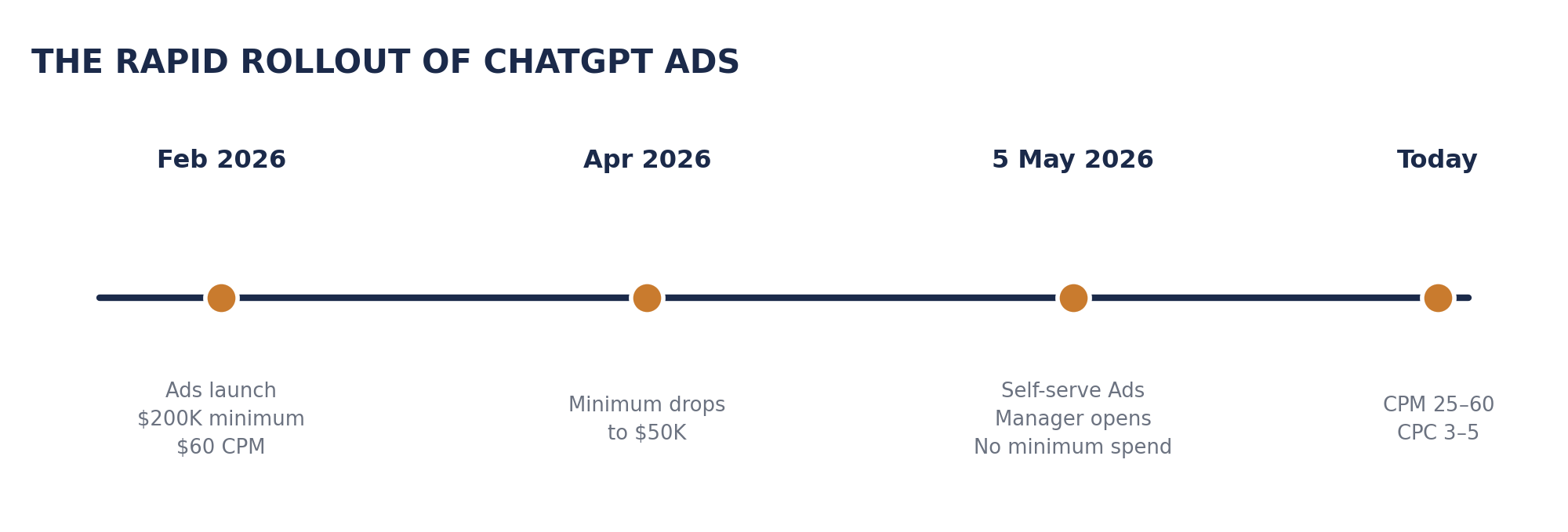
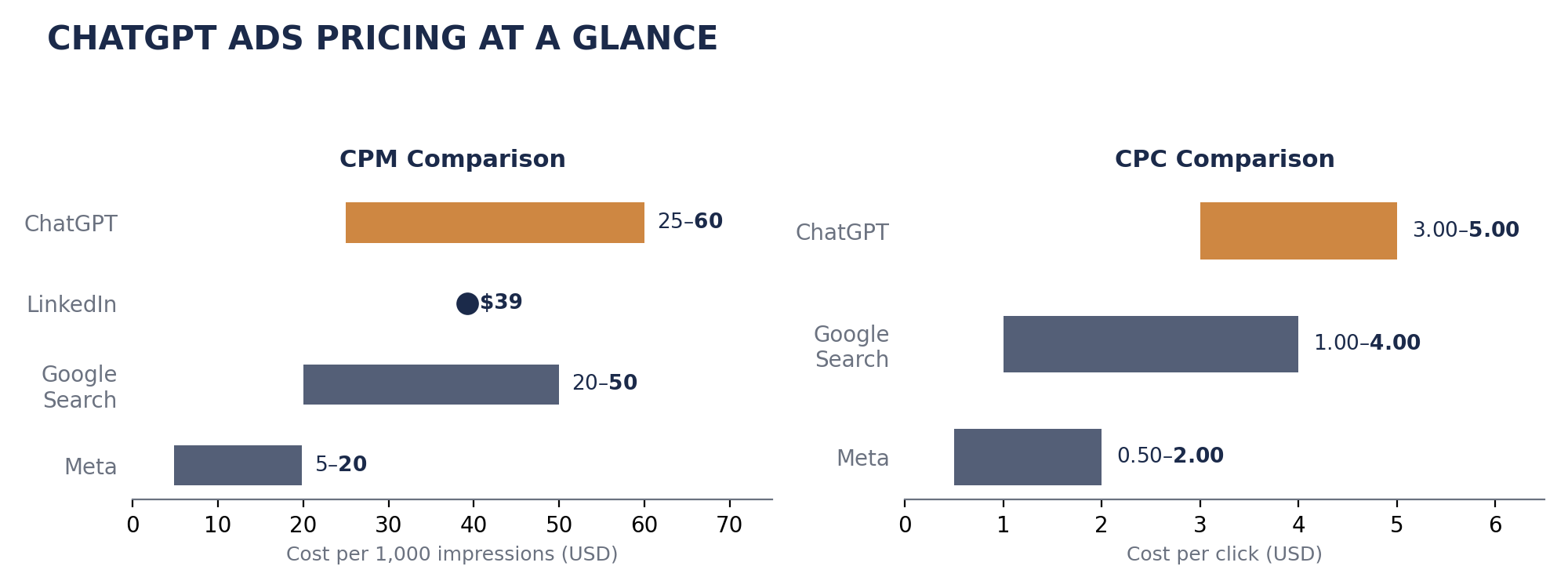
- CPM (Reach objective): Typical clearing rates run roughly $25–$60 per 1,000 impressions, with OpenAI’s default maximum bid still set at $60.
- CPC (Clicks objective): OpenAI recommends starting with a maximum bid of $3–$5 per click, broadly comparable to Google and Meta, though bids that fall much below this floor tend not to deliver reliably.
- No minimum spend: Any approved advertiser can now launch a campaign at whatever budget suits their test, though a realistic starting budget in the region of a few thousand pounds a month is sensible for gathering enough data to optimise.
This positions ChatGPT ahead of Meta and Google Display on a pure cost-per-impression basis, but early data suggests the audience quality helps offset the premium: reports from measurement partners such as Criteo point to ChatGPT-referred traffic converting at roughly 1.5 times the rate of other channels, because users arrive already deep in an active research or buying conversation rather than passively scrolling.
Why ChatGPT Ads Are Relevant Right Now
You are reaching people at the exact moment of intent. Unlike a social feed, where someone might be mid-scroll and only half paying attention, a ChatGPT user has typed out a specific question, problem, or purchase consideration. That’s a fundamentally higher-intent moment than a passive impression, and it’s reflected in stronger engagement and conversion signals.
The audience is enormous and still under-monetised. With hundreds of millions of weekly users and advertising still in its early months, competition for ad inventory is comparatively light. Historically, being an early mover on a new ad platform — think of the first brands into Google Ads or Meta’s early newsfeed ads — has meant lower costs and less competition before the market catches up.
It’s a genuinely new discovery surface. Increasingly, consumers are asking ChatGPT the kinds of questions they used to type into a search engine: “what’s a good gift for a coffee lover,” “best project management tool for a small team,” “where should I book for a wedding anniversary dinner.” If your brand isn’t visible in those conversations, a competitor will be.
Privacy-conscious targeting still works. Because targeting is driven by conversation context rather than invasive tracking or cross-site cookies, ChatGPT Ads sit comfortably within a privacy-first advertising landscape, which matters as third-party cookies and legacy tracking methods keep eroding across the wider web.
The platform is evolving quickly, and being present now builds a head start. Quality scores, audience data, and account history built today will carry forward as the auction gets more competitive later in the year. Advertisers who wait risk entering the channel once costs have already normalised upward.
Why You Should Be Doing This Now, Not Later
New ad channels rarely stay cheap and lightly contested for long. The pattern is a familiar one from Google Ads, Facebook, and TikTok: costs are lowest and returns are highest in the early window before mainstream advertiser demand catches up with supply. ChatGPT Ads are in exactly that window today. Businesses that establish a presence now — building creative that performs, gathering conversion data, and refining context hints — will be better positioned as the platform matures, rather than starting from zero once budgets and competition have driven costs higher.
Beyond cost, there’s a brand-visibility argument too. As more consumers move part of their research and decision-making into conversational AI, being absent from that surface means missing a growing share of the moments that influence a purchase. Testing this channel now is as much about future-proofing your marketing mix as it is about immediate performance.
How Viha Digital Commerce Can Help
ChatGPT Ads are new enough that best practices are still being written in real time, and the platform’s mechanics — context hints instead of keywords, relevance-weighted auctions, conversational ad copy — genuinely differ from the search and social advertising most teams are used to. That’s exactly where our team comes in.
- Account setup and approval: We handle Ads Manager onboarding, business verification, and policy compliance so your account is approved and ready to launch without delays.
- Strategy and budget planning: We help you choose the right objective — Reach or Clicks — set realistic starting bids, and build a testing budget designed to generate meaningful data quickly.
- Creative built for conversation: Ad copy and imagery that perform in a chat context read differently from a display banner or search ad. We craft headlines, descriptions, and context hints tailored to how ChatGPT users actually phrase their questions.
- Tracking and attribution: We implement the ChatGPT pixel and Conversions API alongside your existing analytics stack, so you can see genuine cost-per-acquisition figures rather than clicks alone.
- Ongoing optimisation: As auction dynamics shift and OpenAI rolls out new features, we continuously refine targeting, bids, and creative to keep your cost-per-outcome competitive.
Whether you’re an ecommerce brand wanting product cards in front of high-intent shoppers, or a B2B business looking to get in front of buyers while they’re actively researching solutions, Viha Digital Commerce can build and manage a ChatGPT Ads strategy tailored to your goals.
Get Ahead of the Curve
ChatGPT Ads represent a rare moment: a major new advertising channel, backed by an enormous and highly engaged audience, still in its early and comparatively low-competition phase. The brands that test, learn, and build a foothold now will be the ones with the data, creative playbook, and account history to scale efficiently as the channel matures.
If you’d like to explore whether ChatGPT Ads make sense for your business, get in touch with Viha Digital Commerce. We’ll walk you through the setup, the numbers, and a realistic plan to test this channel properly.





 All-in-One Solution
 Customizable Services
 Assortment of Payment Options
 Optimized Sales Processes
 Omnichannel Maintenance & Support
 Custom Shopping Cart
 Advanced Security & Support
 API Payment & Logistic Integrations
 Social Media Integration